
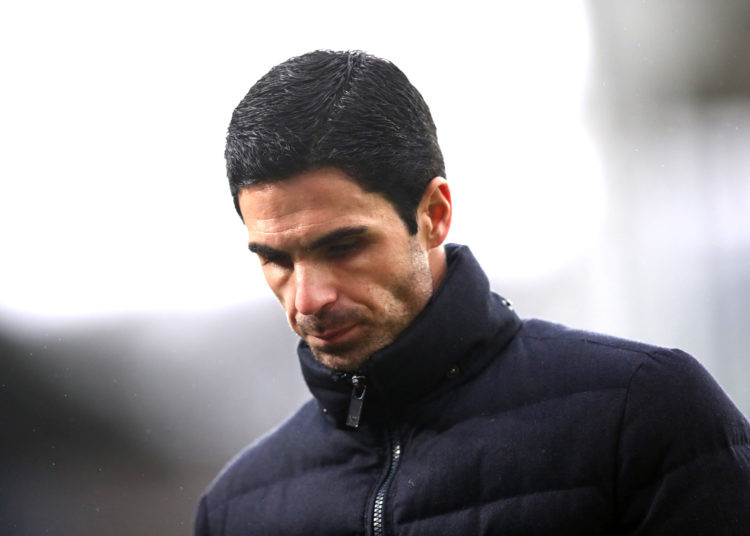
Wembley was supposed to be Arsenal’s moment. A chance to kick-start a quadruple charge, to announce themselves as England’s dominant force, and to hand Mikel Arteta the kind of tangible silverware that had eluded his project since 2020. Instead, Sunday delivered something altogether more sobering for Arsenal, a 2-0 defeat to Manchester City that felt bigger than the scoreline suggests.
Nico O’Reilly, the Manhcester City prodigy, scored twice in the space of four second-half minutes to shatter Arsenal’s afternoon in the most dramatic and deflating fashion. The first goal was a gift wrapped in goalkeeper error, the second a sign of total tactical superiority.
By the final whistle, the questions surrounding Arteta were louder than any noise coming from the blue half of the stadium. He had come into this final with a plan. The problem was, he stuck to it long after it had stopped working, and Manchester City were only too happy to punish him for it.
Pep Guardiola walked into this final knowing exactly what Arsenal wanted to do, and he built his game plan around stopping it at source. Arsenal typically like to spread wide, bait an opposition press, and play through lines using quick passing combinations to open up pockets of space in advanced positions.
To counter that, Guardiola set Manchester City up in a 4-2-4 shape, which was a bold, aggressive structure that was designed not just to disrupt Arsenal’s progression but to actively suffocate it. The back four was organised and compact, but it was what happened in front of it that made the difference.
Players like Bernardo Silva and Matheus Nunes were not used as attackers in the traditional sense. Instead, they operated as forward-thinking defensive anchors, cutting off Arsenal’s routes out and stopping the counter before it could even begin.
Once City had done their defensive work, the transformation was immediate. Rayan Cherki and Jeremy Doku were rotational threats, constantly swapping positions and dragging Arsenal’s full-backs across the pitch, creating overloads in wide areas and numerical advantages for Manchester City in the box.
It was fluid, relentless, and clearly rehearsed. Guardiola had studied his former pupil, Arteta, found the cracks, and exploited them with the kind of clinical precision that reminds you why the Catalan tactician remains in a class of his own.
There is a version of this final where Mikel Arteta’s approach made sense. In the first half, Arsenal were reasonably well-organised, and Manchester City were unable to create truly clear-cut chances. The Gunners pressed in the right moments, Declan Rice commanded his area with authority, and Bukayo Saka offered the occasional burst of danger going forward.
The tactical discipline was evident and, for a period, it worked. Arsenal managed to stay in the game, frustrate Manchester City’s rhythm, and keep the scoreline goalless at the interval. But a plan designed to frustrate is only effective if it comes with a secondary idea, a moment of transition, an attacking burst, something to shift the momentum.
The Gunners never found that second gear. Rather than using the first half’s stalemate as a platform to grow into the match and impose themselves, Arteta opted to stay passive. Manchester City were handed the ball, allowed to recycle possession across all areas of the pitch, and Arsenal sat deeper and deeper, waiting for an error that, outside of one fateful moment from their own goalkeeper, never came.
The elephant in the room, or rather, in the Arsenal goal, was the decision to start Kepa Arrizabalaga over David Raya. Mikel Arteta has rotated between the two in cup competition throughout the season, and on the biggest stage available in domestic football, he opted for a goalkeeper with a grim Wembley history and a well-documented fragility when it matters most.
Kepa’s howler of failing to collect a routine Cherki cross and spilling the ball directly at the feet of Nico O’Reilly was the kind of error that alters narratives. City’s first goal owed everything to that moment, and it immediately handed Pep Guardiola’s side the psychological stranglehold they had been building towards since the second half began.
But the goalkeeper debate should not overshadow a broader absence that haunted Arsenal throughout. The Gunners took the field without a player capable of truly controlling the game with the ball and the sort of technical presence that Martin Odegaard, Mikel Merino, or Eberechi Eze can provide in different ways. Each of those players brings an ability to keep possession under pressure, to slow the game down when needed, and to shift the tempo when Arsenal need to attack.
Without any one of them, Arsenal’s midfield lacked the craft to transition from defensive shape to genuine threat. Declan Rice worked hard and Martin Zubimendi covered ground, but there was nobody to be the heartbeat of a team trying to impose itself on a City side that was growing stronger by the minute.
Mikel Arteta came into this match with a defined strategy: frustrate City, stay rigid, and force them into an error. It was a logical concept on paper. Pep Guardiola’s teams, when under sustained pressure, can occasionally lose their shape and gift opponents a way back in.
The problem was that Arsenal’s defensive-first setup never created the pressure required to manufacture that error from Manchester City. Instead, they handed City the ball, invited them to recycle through midfield, and allowed them to find rhythm in the very areas where they are most dangerous.
When Kepa Arrizabalaga dropped that cross in the 60th minute, City did not just score but broke Arsenal completely. What had been a manageable goalless stalemate suddenly became a 1-0 in favour of City, and Arteta had no clear answer. The substitutions were reactive rather than brave, and City, sensing blood, turned the screw without mercy.
Nico O’Reilly’s second goal, arriving just minutes later, was the final statement. It was not a lucky strike, but the product of a team in total control of a match that their opponents had long since lost tactically. Guardiola did not react to Arsenal. He made them react to him, and they simply could not.
In the cold light of Monday morning, the 2026 EFL Cup final will be remembered as the game where Manchester City reminded everyone that their rebuild is very much complete, and where Arsenal, despite leading the Premier League by nine points, discovered that a league table position does not always translate to trophy-winning capability.
Nico O’Reilly’s brace will be etched into Manchester City folklore, and Pep Guardiola will rightly earn enormous credit for yet another masterclass in tactical preparation and in-game adaptability. But the conversation around this defeat will inevitably, and fairly, circle back to Mikel Arteta.
He had a game plan. It was not a bad one. But football at the highest level demands that a manager thinks in real time, reacts to what is in front of him, and finds a solution when his original idea has run out of road.
Arteta never found that solution on Sunday. He did not throw caution to the wind and push men forward; he did not change his shape decisively; he did not challenge City in a way that forced Guardiola to think differently.
Whether the absence of Martin Odegaard, Mikel Merino, or Eberechi Eze left him too restricted to be aggressive, or whether this was a philosophical decision to play for penalties that ultimately never arrived, the result is the same. Arsenal left Wembley empty-handed, their quadruple dream punctured by a goalkeeper error and a tactical rigidity that their opponents simply outgrew.
With the Premier League title race still in their hands and bigger nights ahead in Europe, Arsenal will have chances to rewrite this story. But for Arteta, the most important lesson from Wembley is simple: having a plan is never enough. Knowing when to abandon it is what separates the good from the great.
