
Our Get German Football News Bundesliga 2026/27 Tactical Previews series continues with a trip to the Osterdeich. Having already covered the offseason of one Hanseatic city-state club, it’s time to check in with HSV’s Nordderby rivals. Fortunately, Werder Bremen presently find themselves in much better shape than when we assessed their fortunes last year. In point of fact, this whole organization feels different than the disorganized and stubborn rabble that can’t keep track of its loan quota and routinely declines to commit to major decisions. Perhaps Clemens Fritz’s back has grown weary of being perpetually against the wall. We enter uncharted territory. Mostly the same administrators suddenly possess conviction and authority. The author doesn’t know exactly what to expect.
This Hanseatic club always seems to be broke despite its size and sizable supporter base. As a result, every summer transfer window brings with it at least one signing (Naby Keïta or Victor Boniface to name just two) that seems like a steal until one discovers something was inherently wrong with them to begin with. Either that, or the vast majority of the summer transfer budget gets blown on some mediocre performer like Samuel Mbangula while nothing else works. Candidly, we don’t quite know what this year’s version of a high-profile signing shall deliver. Niclas Füllkrug has graciously accepted remittance in emotions and passion. How very nice of him. It shall prove interesting to see if Werder are pumping yet another dry well.
At least captain Marco Friedl should be prepared for whatever comes next. The Austrian has spent several years serving as Werder’s resident emergency-broadcast system. Last year, after another miserable summer and an opening Pokal elimination, the captain summarized the situation rather efficiently by announcing that Werder were “in deep shit”. By the following February, with Daniel Thioune newly installed and Bremen sliding into the relegation playoff place, Friedl had progressed to declaring that his team were “back where we belong”. This is what leadership sometimes looks like in northern Germany: captain’s armband, defensive organization and occasional public-service announcements concerning the precise depth of the manure.
This Bundesliga campaign may be different.
One nevertheless still senses that it will remain uncomfortable.
Bremen’s summer has mixed major sales with bargain recruitment, academy promotion and one spectacularly sentimental loan return, all while the club’s finances ensure that a healthy transfer surplus does not translate into anything resembling a shopping spree. Füllkrug may have supplied the emotional headline, but the departures of Backhaus, Schmid and Coulibaly have altered the spine of the team. New squad planner Markus Pilawa might be the most important summer addition. Even though he sits far down in the proverbial front office totem pole underneath Fritz, Peter Niemeyer, and several others, the former Bayern and Dortmund scout may be the primary reason behind this club’s different “feel”.
Estimated Summer Transfer Balance = +€33.4m
Werder’s summer transfer balance looks considerably healthier than Werder’s summer transfer budget. More than €40m has arrived through three major sales alone, yet the peculiarities of the club’s finances mean Clemens Fritz has not spent August wandering around Europe with a company credit card. To reiterate a point that this writer never quite understood, this club is just simply always broke. Revenue streams remain irrelevant for some unknown reason. It is simply always so. Accept. Bremen instead rebuilt the squad through free transfers, modest fees, academy promotion and, eventually, one wonderfully sentimental loan. Pilawa appears to have helped Werder become considerably more decisive about identifying profiles, establishing prices and moving on when necessary.
Niclas Füllkrug supplies the biggest headline. The 33-year-old returns from West Ham on a one-year loan without a purchase option after accepting a substantial salary reduction to make the deal possible. Werder had already signed highly excited Bundesliga returnee Cedric Itten on a free following his 15-goal league season with Fortuna Düsseldorf, while 20-year-old Salim Musah used camp to transform himself into a genuine first-team option. Eren Dinkçi’s €400,000 loan return from Freiburg at the very least added some much-needed pace to the roster. Prospective future attacking prospect Kenny Quetant (19) also arrived on a free.
The more fundamental changes came elsewhere. Mio Backhaus joined Freiburg for €12m after establishing himself as Bremen’s first-choice goalkeeper last season. Werder responded by making Karl Hein’s Arsenal move permanent for around €3m and then added Austrian international Alexander Schlager on a free. Romano Schmid’s €8.5m move to Frosinone removes one of Werder’s most important creative players. That’s actually a huge move that one wishes Pilawa or someone in that front office could have prevented. Alas, an Italian club flush with cash appears to have ensured that Werder’s Austrian oak can earn more elsewhere. New Spanish signing “Chuki” (on a free from Real Valladolid) literally has some enormous boots to fill.
Karim Coulibaly has officially completed a €20m move to Strasbourg, with Werder also securing a ten-percent sell-on clause. The 19-year-old leaves only two years after arriving from Hamburger SV’s academy and after 27 competitive first-team appearances. Combined with Backhaus and Schmid, his departure pushes Bremen’s reported income from those three players alone beyond €40m. That is where Pilawa’s (presumed) influence becomes more interesting than one glamorous signing ever could. Werder’s summer has largely been about extracting value from a restricted budget rather than attempting to solve financial limitations by pretending they do not exist.
Not every one of those moves will work. Werder supporters are painfully familiar with that particular concept. In any event, the turnover is substantial. The spending is not. Bremen have sold their starting goalkeeper, primary creative midfielder, and most valuable young defender, while leading goalscorer Stage could theoretically still follow. In response, they have assembled a deeper squad through free transfers, loans, inexpensive recruitment and internal development before bringing Füllkrug home to solve the problem most likely to provoke emotional rather than financial accounting.
Werder opened with a 6-2 win over Oberliga side FC Verden 04. Justin Njinmah and Jens Stage nabbed two goals apiece. Musah notched two goals. Paul Erevbenagie also scored. That would become relevant rather quickly. The first Austrian-camp friendly against Fagiano Okayama supplied the first meaningful look at Thioune’s midfield ideas. Werder began in something resembling a 4-2-3-1 before Patrice Čović dropped into the single holding role, Stage advanced and Chuki moved alongside him as the second eight. The 4-2-3-1 had become a 4-3-3 without anyone needing to walk over to the touchline and file the sort of paperwork usually required to get anything done at this Hanseatic club.
That mattered because Senne Lynen, the player intended to occupy the holding-six position permanently, missed virtually the entire camp with abdominal problems. Chuki nevertheless made the experiment look promising, scoring from outside the penalty area and adapting surprisingly well to the physical demands of (albeit unofficial) football outside of Spain’s second division. Chuki scored the first goal in the 2-0 victory. Mbangula set up the second with a fine free kick. Bochum then provided a more serious test over the course of two 60-minute halves. Erevbenagie scored and Musah won and converted a penalty as Werder followed the 2-0 Okayama victory with another 2-0 win. The defensive stability remained. The attack still needed plenty of work.
That distinction became clearer against Energie Cottbus. With several natural full-back and wing-back options missing, Werder experimented heavily and occasionally produced football that resembled interpretive dance. Karl Hein gifted Cottbus an early opener with a risky buildup pass before Stage released Musah for the equalizer. Musah then assisted on Mbangula’s 2-1, completing his most convincing performance of the summer. Werder changed the entire side by the hour and became considerably less coherent, but Erevbenagie scored again anyway. Chuki then eventually sealed a flattering 4-2 victory. Four friendlies into preparation, Musah and Erevbenagie earned themselves plenty of dark sharpie ink in the author’s notebook.
SC Paderborn then subjected everyone to a 4×35-minute test that sounds less like a friendly than something requiring a liability waiver. Some of it has already been covered in the SCP section. Another enormous absence list meant Thioune still could not field anything resembling his intended first XI, and Paderborn were comfortably better for long stretches. Hein repeatedly kept Werder level before Marco Grüll finally supplied a good decision on the left and set up Njinmah for the opener. Erevbenagie later finished a counterattack for his fourth preseason goal. By then, the academy story had stopped being cute: goal against Verden, assist against Okayama, goal against Bochum, goal against Cottbus, goal against Paderborn. As if it mattered, the score finished 2-2.
Werder’s final friendly against AJ Auxerre provided one last tactical test. Thioune’s nominal 4-2-3-1 defended as a 4-4-2, with Chuki joining Cedric Itten in the first pressing line. Olivier Deman pushed aggressively forward from left-back in possession and Samuel Mbangula alternated between holding the width and moving inside. The combination worked well at times and allowed Mbangula to operate much more naturally as an attacking winger.
The problems appeared after turnovers. Thioune complained afterwards that Werder lacked sufficient will to defend in transition, and Auxerre’s winning goal illustrated the issue. Marco Friedl stepped out of the defensive line, the distances around him opened and Arthur Piedfort exploited the resulting space to score. The 1-0 defeat therefore ended preparation with another useful look at both the possibilities and the risks contained within Thioune’s increasingly aggressive possession structure.
Few newcomers benefited more from actually getting onto the pitch early. Chuki arrived from Spain’s second division carrying reasonable questions about physical adaptation and proceeded to spend July answering most of them considerably faster than anticipated. Against Okayama, he moved between the No. 10 and advanced-eight positions before scoring neatly from distance. Set-piece responsibility followed. So did increasingly complicated tactical assignments. By the Auxerre Generalprobe, Thioune was asking him to operate as an attacking midfielder in possession and join the striker in the first pressing line without the ball.
Romano Schmid’s subsequent departure makes that successful adaptation substantially more important. Werder still want another creative midfielder and should not pretend a free transfer from Valladolid automatically replaces one of their most influential attacking players. Chuki has nevertheless shown that he needn’t spend half a season being carefully unwrapped. He can play as an eight, a 10 and part of the first pressing line, while his left foot already offers something distinctive from open play and dead balls. There are few more dangerous substances in football than a technically gifted newcomer scoring from 20 metres in preseason. For once, Bremen may be permitted a small sip.
Last summer’s expensive newcomer entered this one requiring something closer to rehabilitation. Werder had spent roughly €10m on Samuel Mbangula before a disappointing first Bundesliga season in which the winger was occasionally asked to perform wing-back duties that did neither player nor club many favors. Thioune’s attempted reset has at least restored the correct starting point: Mbangula is an attacker again. The Auxerre test offered the clearest demonstration of why that matters.
Olivier Deman pushed aggressively beyond him while Mbangula alternated between holding width and moving inside, creating different occupation of the same flank rather than two players simply running into one another. When Deman went outside, Mbangula could narrow. When Mbangula stayed wide, Deman could attack beyond or inside him. There were also defensive responsibilities whenever the full-back wandered approximately into another postal code, but even those made considerably more sense than treating Mbangula as the nominal defender himself.
Werder spent the summer rebuilding at the striker position and the 20-year-old still possesses a legitimate claim to start. Musah created Bremen’s first three goals against Verden, remained one of the better performers in Austria, won and converted a penalty against Bochum and then produced a goal plus assist against Cottbus. Even after illness interrupted the latter stages of preparation, he returned to threaten against Auxerre twice. The 1.98-metre striker is not particularly quick, but he can secure difficult balls, occupy centre-backs and turn physical possession into something useful rather than simply standing around being very large. Füllkrug’s arrival obviously makes the pathway more crowded, but Musah nevertheless leaves camp having ensured that the question of whether he belongs in the first team is a question no more.
Everyone get used to pronouncing this name! There are productive preseasons and then there are attempts to make one’s continued classification as an academy player look faintly ridiculous. Paul Erevbenagie began the summer as an 18-year-old moving up from Werder II and ended it having forced himself squarely into Daniel Thioune’s first-team calculations. The quality of the opposition increased. The senior-level absences gradually disappeared. Erevbenagie kept doing things anyway. Thioune has been appropriately careful about the rougher edges. Erevbenagie’s decision-making remains that of an 18-year-old and there will inevitably be moments in which the correct senior-football option arrives several seconds after he has chosen a more entertaining one. He still entered camp as an intriguing Werder II prospect and leaves it as a player Thioune may actually have to find Bundesliga minutes for.
Deman’s resurrection may be the quietest significant hierarchy development of the summer. Injuries and uneven form had previously pushed the Belgian toward the edge of Bremen’s plans. Instead of arriving at camp waiting for the club to purchase his replacement, he emerged as the current favorite on the left and gradually became one of the most important pieces in Thioune’s developing possession structure. The Auxerre test offered the clearest demonstration. Deman did not merely overlap Mbangula. He pushed high enough to alter Bremen’s buildup shape behind him, leaving three players in the construction while creating different heights and angles down the left.
That aggression obviously carries risk, particularly when possession turns over and Bremen suddenly have to defend the space Deman has vacated. Thioune will need the distances and counterpress behind him to work considerably better than they occasionally did during camp. The hierarchy point nevertheless remains striking. Bremen began the summer debating whether another full-back was an absolute necessity. Deman’s performances helped reduce that urgency. For a player whose Bremen future once looked considerably less secure, moving from possible surplus to tactical mechanism is a fairly convincing camp victory.
If returning to work under a coach who already knows you sounds like the beginning of a redemption story, Dawid Kownacki unfortunately appears to have misplaced the next chapter. Thioune has been perfectly willing to integrate the Pole into training and preparation, but nothing that happened over the summer materially altered Bremen’s broader assessment of his future. The striker returned from Hertha needing to force his way back into the plans. The author keeps his narrative-based transfer story from last summer at the ready.
Talk about a chapter that needs to be closed! Skelly Alvero returned from Amiens facing essentially the same assignment as Kownacki: convince a new coach that there was still a meaningful Werder role hiding somewhere inside the squad. He did not. Chuki immediately showed he could handle several advanced roles. Dariusz Stalmach received experimental minutes as the deepest midfielder. Ludovit Reis arrived to increase central competition. Senne Lynen remains the intended six once healthy. Previous transfer arc stories are once again sitting in the standby pile.
The author is most displeased about this one. Grüll is just an awkward case, especially now that his friend Marvin Ducksch is long gone and his Austrian compatriot Schmid has departed. Camp presented him with a particularly inviting opportunity to claim attacking minutes and instead produced a string of poor decisions and visible confidence problems. There were stretches in which Grüll chose the wrong option with sufficient regularity that one began wondering whether he had embarked upon some form of experimental research.
His response deserves credit. Against Paderborn, Grüll finally beat his opponent down the left and supplied the assist for Njinmah’s opener. That prevented the summer from becoming a straightforward collapse and moved him closer to neutral territory. It did not, however, erase the larger hierarchy issue. Mbangula looks increasingly established on the left, Erevbenagie has kicked down several doors and Dinkçi adds another quick attacking option. Grüll entered camp with a position available to be won and leaves without having won it.
The first competitive evidence rather neatly confirmed that Thioune’s summer diagrams were not merely decorative. Against Lüneburger SK Hansa, Bremen began from the single-six structure they had spent most of preparation trying to establish. The author settled in for this mismatched affair sincerely hoping that it wouldn’t prove as ridiculously lopsided as Frankfurt’s opening round Pokal fixture. After 45 minutes of genuinely boring football, he then found himself wishing that it had. German match commentators once again had to resort to their “reserve bank” of storylines. The fact that the hosts rented out the Millerntor stadium for this special encounter must have been repeated 2,352 times.
How did the opening tactical plot look? An easy enough to discern 4-3-3/4-1-4-1 hybrid featured several players one didn’t get a chance to scout in camp. Füllkrug and Reis were immediately inserted into the starting XI. Senne Lynen returned from his abdominal problems and occupied the deepest midfield holding-six position. Samuel Mbangula and Justin Njinmah supplied the width around Füllkrug. Deman held onto his starting left-back role. Amos Pieper replaced the departed Coulibaly in central defense. With Mitchell Weiser, Felix Agu and Oskar Wójcik all still unavailable, 18-year-old Mick Schmetgens continued to fill in at right-back. The lone first-half goal came off a set play.
Lineup–SVW (DFB Pokal)
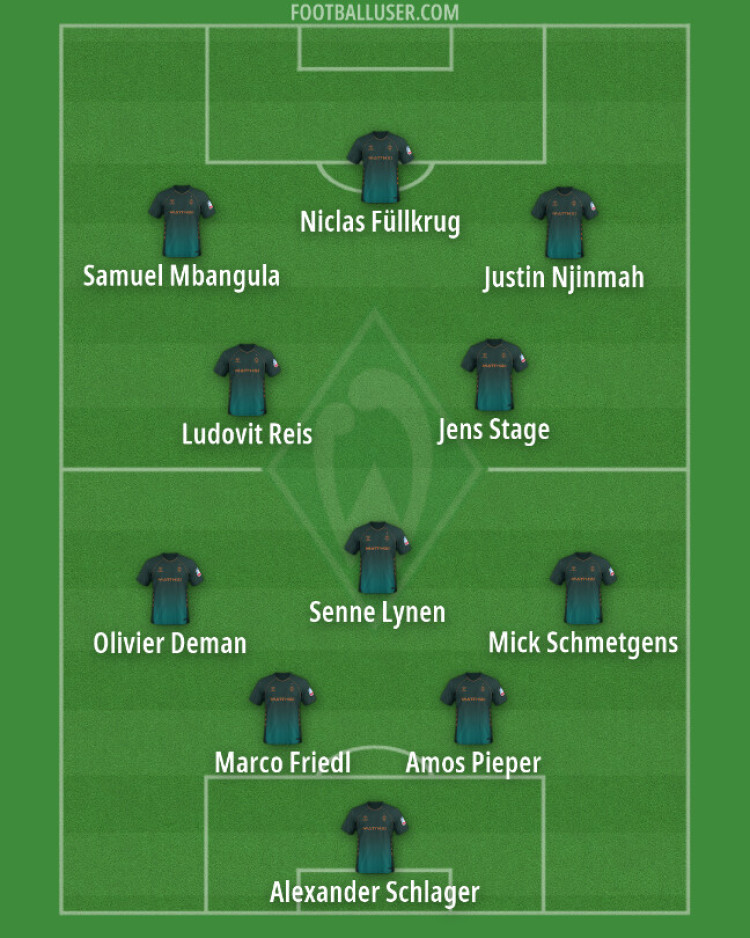
Lüneburg retreated extremely deep. Werder monopolized the ball and the entire match gradually compressed toward one penalty area. The important detail was how Thioune arranged that possession. Lynen remained the single holding midfielder, Reis and Stage worked ahead of him as the two eights and Mbangula and Njinmah stretched the pitch around Füllkrug. Lynen operated quite deep, while Stage repeatedly attacked higher spaces rather than behaving like a conventional central midfielder. Reis looked for combinations closer to the front line. The pattern was visible within seconds when Stage crossed from the right and Reis arrived to shoot over from 13 metres.
The 1-0 reminded one just how different set-piece drilling is at these footballing levels. Deman delivered a left-sided corner in the 11th minute and Stage headed home from seven metres. Mbangula nearly helped produce another immediately afterwards, first finding Füllkrug with a corner from the opposite side and then testing Lüneburg goalkeeper Exner himself from a free kick. Werder remained dominant without ever playing at particularly frantic speed. Füllkrug already looked comfortable as the central reference point, dropping and laying a Schmetgens cross back toward Stage for another chance. Reis combined neatly with Njinmah for a shot shortly before the interval. Deman also continued his aggressive summer role from left-back and forced a save after arriving at the edge of the area just before halftime.
The more encouraging defensive detail concerned what happened whenever Bremen lost the ball. Thioune had complained about insufficient aggression in transition after the Auxerre friendly; here, the counterpress repeatedly prevented Lüneburg from finding any meaningful relief. The 1-0 halftime score therefore understated Bremen’s territorial control more than it reflected any genuine danger from the underdog. What it did reveal was a familiar issue at the other end: plenty of possession, several promising positions and only one goal to show for it. Thioune consequently used the interval not to abandon the structure, but to change two of the players operating within it.
Lineup–SVW (46th minute)
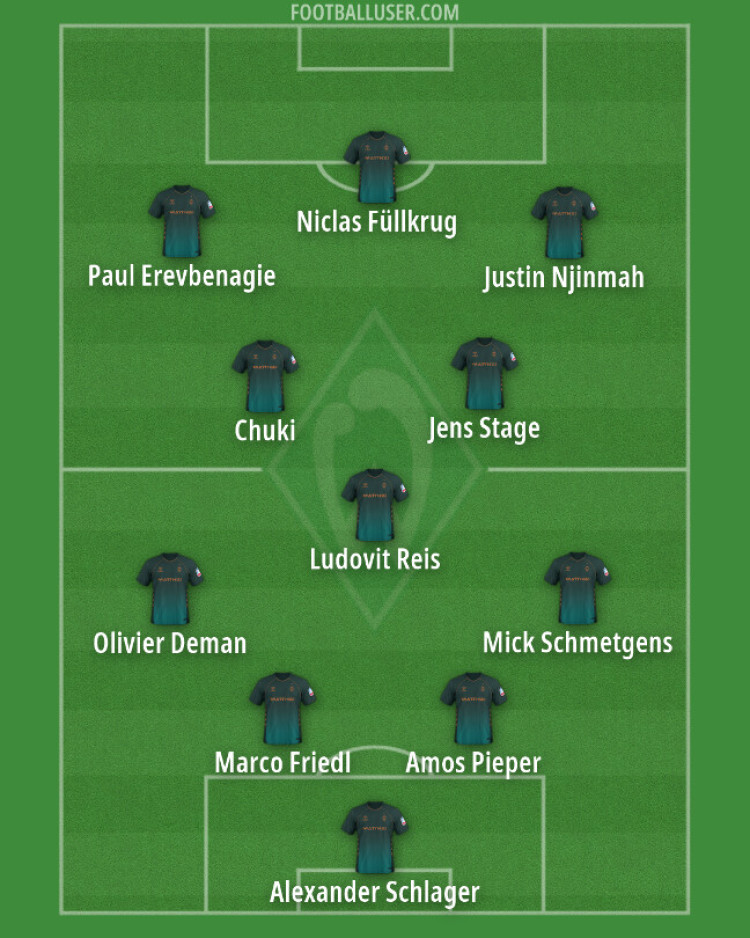
The halftime changes altered the personnel more than the basic idea. Lynen’s withdrawal had been planned after the holding midfielder missed most of preparation, while Mbangula’s afternoon ended after an underwhelming first half. Chuki replaced Lynen and Erevbenagie took over from Mbangula. Reis consequently became the deepest member of the midfield trio, although he interpreted the role rather more aggressively than Lynen had. Instead of remaining permanently stationed in front of the centre-backs, the newcomer continued stepping higher when possession allowed. Chuki assumed the advanced-eight work Reis had performed before the break. Stage retained his attacking freedom on the other side. The single-six concept therefore survived, but the distances became a little less rigid.
The impact was immediate. Chuki arrived in the sort of spaces Werder had struggled to exploit consistently before halftime and saw a 51st-minute effort deflected narrowly wide. Seconds later, Stage drove toward the byline and drew the foul that allowed Füllkrug to mark his return with a confidently converted penalty. Erevbenagie’s introduction was less spectacular statistically, but significant hierarchically. The prospect we spent significant time fawning over above has now been handed an entire competitive half when Thioune wanted greater attacking impetus.
Füllkrug made way for Itten on the hour in a straightforward change of reference striker, but Bremen continued to create more as Lüneburg tired. Njinmah nearly added the third after lifting the ball over Exner, only for Muhlack to clear from the line. Chuki remained heavily involved, twice finding shooting positions around the 72nd and 73rd minutes. Itten increasingly occupied the penalty area. One Chuki effort even caught the Swiss striker’s head and flew narrowly over. The third eventually came from Reis. Pieper found him outside the box in the 76th minute, Reis stepped forward from his deeper starting position and drove a slightly deflected left-footed effort under the crossbar.
The goal rather neatly illustrated how he had interpreted the second-half role: nominally responsible for replacing Lynen underneath the other midfielders, but hardly chained to the base of the structure. Thioune then continued refreshing the attacking positions. Marco Grüll replaced Njinmah, Musah received the final minutes in place of Stage. Itten twice threatened with headers, including one against the crossbar from another Deman delivery. Musah also immediately drove into shooting range and narrowly missed from 15 metres.
Against Lüneburg, Bremen’s counterpress largely prevented the opponent from developing transitions at all. The level of opposition prevents us from declaring the problems inherent in the Auxerre match solved. The behavioral response was nevertheless obvious. More revealing was how comfortably Bremen could alter personnel without discarding the structure. Lynen began as the orthodox six. Reis then assumed the deeper responsibility while continuing to venture somewhat higher, Chuki moved into the advanced midfield line and Erevbenagie replaced Mbangula directly on the wing. Füllkrug gave way to Itten without requiring another systemic rewrite. Thioune’s preseason work therefore appears to have produced something genuinely useful.
Please note the careful wording there. “Something genuinely useful.” Nobody around the Weser should begin behaving irrationally. Bremen have spent enough summers discovering that the suspiciously inexpensive object they found at the transfer-market flea market either lacks several important components or begins leaking oil halfway through September. Reis nevertheless arrived approximately five minutes ago and already looks capable of performing several midfield jobs. Chuki can move about with some creative license. Erevbenagie has apparently decided that the depth chart is meant to be suggestive only. Füllkrug has returned, scored immediately, and appears okay accepting a “mini-jobber’s” paycheck.
For the moment, at least, the dry well appears to contain water.
Then again, this was Lüneburger SK Hansa. Bundesliga opposition will be rather less cooperative about allowing Reis to wander forward, Deman to disappear toward distant postal codes and Bremen’s counterpress to recover every misplaced ball before anything unpleasant happens. Freiburg should provide a much more meaningful examination of whether Thioune’s new structure actually works when somebody pushes back. Until then, the author advises against declaring that Werder have finally given us cause to believe they won’t factor into the relegation race.
Marco Friedl’s emergency-broadcast system should remain switched on.
