
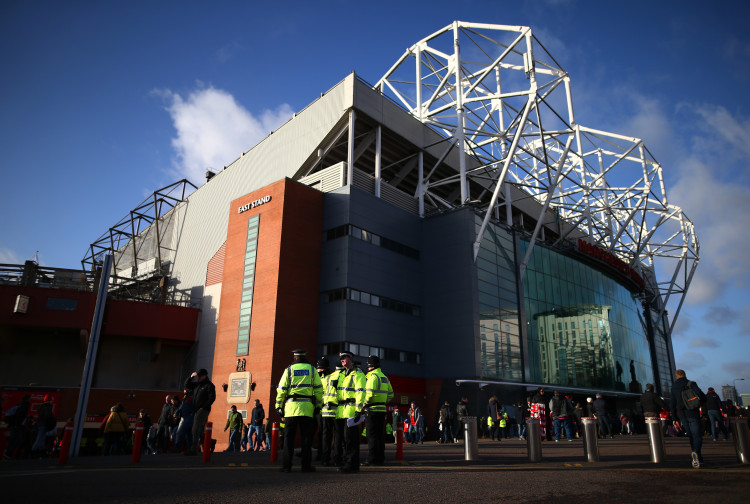
Manchester United vs Tottenham Hotspur at Old Trafford on Saturday will have the spotlight on the two managers, neither of whom can afford another slip-up.
Matheus Cunha’s deflected effort in the 89th minute rescued Manchester United in a 1-1 draw at Fulham, while Tottenham’s last league outing ended in a humiliating 2-3 defeat to Aston Villa. Those results explain why this meeting at Old Trafford has been labelled the “El Sackico” in some quarters. Michael Carrick and Roberto De Zerbi both need their teams to respond after the international break.
The result matters to both clubs, but not in exactly the same way. Manchester United are trying to recover ground towards their expected level, while Tottenham are attempting to stop a damaging start becoming a season-long crisis. A win would improve either manager’s position, yet neither side is facing a mathematically decisive fixture. That should produce urgency without guaranteeing an open game from the start.
For the home side, this is a chance to turn a pressured position into something more stable. They sit 12th with five points after five matches, and victory can move them only into the top half of the table. A defeat would deepen the pressure around Carrick, while another draw would leave a side that has won only once in the league still searching for momentum.
The Red Devils have scored 12 goals in their last five matches and have conceded six, but the 1-1 draw at Craven Cottage showed the frustration in their current run. They created enough to expect more, yet needed a late deflection to avoid losing. The main question is whether the reshuffle that has put Cunha centrally can make their possession more decisive.
Tottenham’s situation is more severe emotionally, particularly in the wake of their heavy summer outlay. Spurs are bottom with two points, and even a victory can only move them only into the lower mid-table spots. Another defeat would leave De Zerbi under still greater scrutiny, while a draw would offer limited relief to a winless team.
Spurs’ recent return is only two goals across four matches, against five conceded, and the Villa loss followed a sequence in which control of the ball failed to produce enough threat. That makes this an unusual away assignment: Tottenham need a result, but their recent problems give them reason to protect the game rather than turn it into a reckless contest.
Manchester United will be without Manuel Ugarte, Patrick Dorgu, Benjamin Sesko, and Noussair Mazraoui, while Amad Diallo remains doubtful despite resuming training. Matthijs de Ligt is returning from a back injury but won’t be fit to start. The missing defensive and midfield options narrow Michael Carrick’s ability to change the balance of the side, which helps explain the continued selection of a 4-2-3-1 with two players protecting the build-up.
Senne Lammens should retain his spot between the sticks behind Luke Shaw, Lisandro Martínez, Harry Maguire, and Diogo Dalot. Dalot is expected to retain the right-back role despite a quiet start to the season, and Martinez continues on the left side of central defence.
As for the midfield unit, Kobbie Mainoo and Youri Tielemans should form the double pivot. The attacking structure runs through Bruno Fernandes, Bryan Mbeumo, Marcus Rashford, and Matheus Cunha. Fernandes has three goals and 13 key passes, making him the player United are most likely to seek between Tottenham’s midfield and defence.
Mbeumo has added two goals and 10 key passes from the right, while Cunha has one goal, one assist, and three big chances created as the central reference. Rashford should continue from the left, although Manchester United still need his movement to become more than a way of opening space for others.
Probable Manchester United Lineup (4-2-3-1): Lammens; Dalot, Maguire, Martinez, Shaw; Tielemans, Mainoo; Mbeumo, Bruno Fernandes, Rashford; Cunha
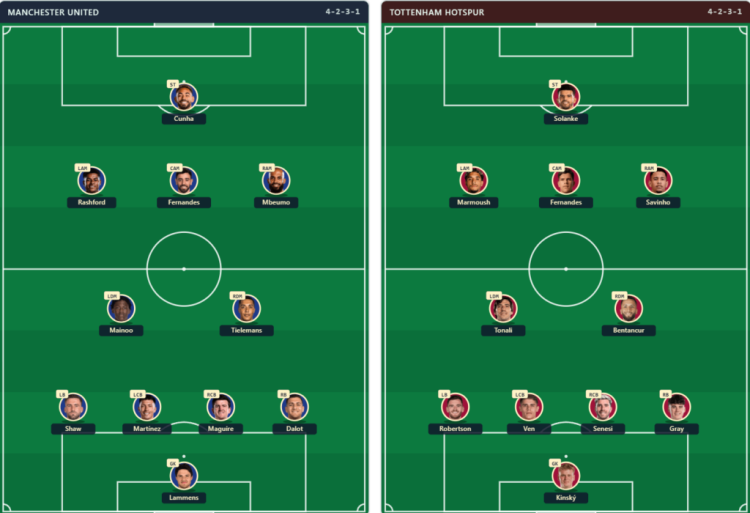
Probable Tottenham Hotspur Lineup (4-2-3-1): Kinsky; Gray, Senesi, van de Ven, Robertson; Bentancur, Tonali; Savio, Mateus Fernandes, Marmoush; Solanke
Tottenham have Mykhaylo Mudryk, Xavi Simons, and Wilson Odobert out. Jan Paul van Hecke is a doubt with a foot injury but has been declared available for selection, while James Maddison is also doubtful after losing fitness during the international break. The defensive uncertainty and the absences in attack leave the 4-2-3-1 as the safer choice, preserving two central midfielders rather than adding a second forward.
Antonín Kinsky should start behind Andrew Robertson, Micky van de Ven, Marcos Senesi and Archie Gray. Robertson has contributed one assist, eight key passes and three big chances created, giving Tottenham an important route forward from the back. Sandro Tonali and Rodrigo Bentancur should sit in front of them, with Tonali offering the more direct passing route and Bentancur responsible for closing the central lane.
Mateus Fernandes is likely to play behind Dominic Solanke, with Omar Marmoush on the left and Savio on the right. The Brazilian has nine key passes and two big chances created in his three starts, making him Tottenham’s most productive recent attacking outlet by chance creation. Solanke remains the natural focal point, though he has managed only one shot on target. The front four need to convert Spurs’ possession into more than circulation around the United block.
Both teams should use a 4-2-3-1 setup, yet the purpose is not identical. Manchester United’s shape keeps Kobbie Mainoo and Youri Tielemans behind Bruno Fernandes so they can attack with control rather than sending the whole side forward.
Tottenham’s version also protects the middle, but for a different reason. Two midfielders give them enough support to pursue a win while keeping a draw available away from home. United are expected to carry the game; Tottenham can wait for the match to offer them a safer moment.
This meeting could become a contest for territory without immediately becoming a high-risk shootout. Manchester United have held 57% of the ball and Tottenham 59%, both well above the 47% league-typical figure. United also take 21 shots per match against Tottenham’s 14, with the league average at 12.5.
The hosts therefore carry the greater appetite to finish attacks, while Tottenham’s possession habit does not automatically imply a comparable attacking return. The physical contrast is clearer in the contests around midfield. United average 85 duels per match, Tottenham 100, with the league typical figure at 95.5.
Tottenham are more likely to make the match a repeated fight for loose balls, while United’s lower involvement in those contests suggests that their preferred route is to keep the ball moving and find Fernandes before the game becomes too broken. Both sides also play fewer long balls than the league average, with United on 43 and Tottenham on 33 against 49 typically, so neither is built around simply bypassing the midfield.
That brings the broader tactical problem into focus. Manchester United’s recent attacking process has produced 2.29 expected goals per match across five games, but the 1-1 draw at Fulham showed the difference between creating enough and forcing the decisive opening.
Tottenham have averaged 1.14 expected goals across four matches, and their possession can become harmless if the hosts keep the central lanes connected. The home side must turn control into penetration before Spurs can settle into the measured game they prefer.
Bruno Fernandes is expected to seek the space between Tottenham’s midfield pair and centre-backs, while Rodrigo Bentancur should be the player responsible for closing that route. The Manchester United skipper arrives in stronger attacking form, with three goals and 13 key passes already, whereas Bentancur’s role is less about joining the final action and more about stopping the central pass from reaching the playmaker.
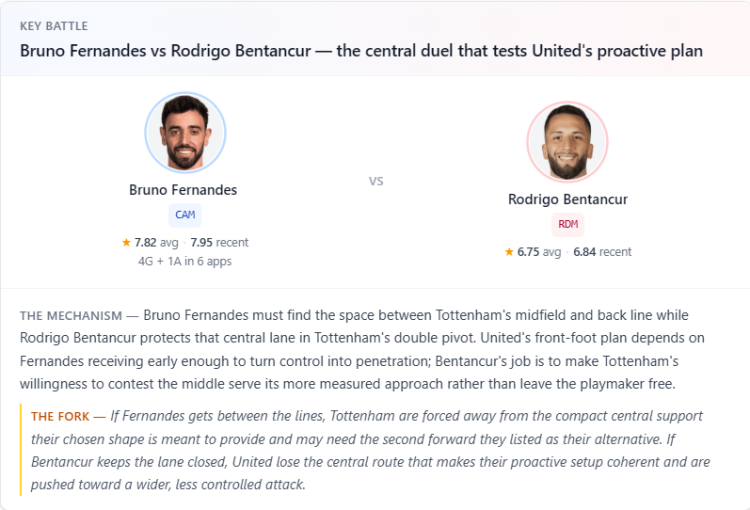
If Fernandes receives early between the lines, Tottenham may be forced to abandon the compact support their shape is designed to provide. That would give Manchester United’s wingers more room and could make Spurs defend deeper than they want.
If Bentancur keeps the lane closed, United lose the central route that makes their proactive plan coherent and will have to rely more heavily on wider attacks. Behind Fernandes is the double pivot, but that cover cannot replace the penetration he provides ahead of it.
The second important collision is on Manchester United’s right, where Bryan Mbeumo should test Andrew Robertson. The Cameroonian international has scored twice and supplied 10 key passes, while Robertson’s value is in containing that threat without allowing the backline to be stretched.
If Mbeumo wins the exchange, Tottenham may have to narrow their whole structure and reconsider whether a second forward can be added later. If Robertson controls it, Manchester United lose one of their clearest outlets and may need to sacrifice some of their central protection to create another route.
We are leaning towards a Manchester United win, held with medium confidence rather than strong conviction. The key separation is attacking output. Manchester United’s 2.29 expected goals per match stand against Tottenham’s 1.14. The Red Devils have also allowed 0.98 expected goals per match compared to Spurs’ 1.13, giving the home side the better platform at both ends of the pitch.
That advantage should matter if Bruno Fernandes can receive behind the Tottenham midfield and if Bryan Mbeumo can stretch Andrew Robertson’s side of the defence. The hosts are not being asked to chase a mathematical emergency, but their need to turn control into a result is more visible than Tottenham’s need to force the game open.
A home win is therefore the most logical match-result call, though the margin for error is narrow. The strongest case against Manchester United is that Tottenham can slow the match through possession and repeated midfield contests. Spurs average 60.8% possession in their recent aggregate and have shown they can keep opponents defending for long periods, while their higher duel involvement may disrupt United’s preferred circulation.
If Rodrigo Bentancur denies Fernandes and Dominic Solanke occupies Harry Maguire, Tottenham can keep the draw alive and make Manchester United’s proactive shape look like possession without enough clear access. The likely scoreline range is 2-1, 2-0 or 1-1.
Tottenham have a clear late adjustment if the game demands more. Switching to 4-4-2 would add a second central forward, but it would reduce the midfield support that currently protects their build-up.
Manchester United have their own option in a 4-3-3 if they need another attacker, though that would also reduce central cover. The first change is more likely to alter the game’s balance because it would force the home side’s defenders to deal with a different reference point rather than simply facing the same structure with greater urgency.
