

Manchester United vs Bournemouth at Old Trafford on Sunday will be a match featuring a manager under scrutiny after European embarrassment and another flying high on confidence after three successive wins.
Manchester United’s 4-1 defeat to Como in the UEFA Champions League turned a poor run into a crisis, while Bournemouth followed a 2-0 win over Sunderland last weekend with a 3-0 victory over AC Milan in the UEFA Europa League. That contrast gives this meeting its shape. The hosts need an immediate response at Old Trafford, whereas Bournemouth arrive with momentum and the freedom to test a troubled opponent.
The points matter to both clubs in an early-season race, but neither side is facing a mathematically decisive afternoon. For Manchester United, a victory would calm the scrutiny around Michael Carrick and keep the Champions League target within reach.
Another draw or defeat would deepen the sense that the season is drifting, especially after the latest European collapse and a run of seven matches without a win in all competitions. Bruno Fernandes has already questioned Carrick’s tactics publicly, so United are not only trying to improve their results; they are trying to show that the manager’s plan still has authority.
Bournemouth, on the other hand, can approach the same match with a different perspective. Their three successive wins have lifted the mood around Marco Rose, and another positive result would strengthen a European push that still looks reachable from their current position.
A defeat would not undo the recent progress, but it would halt the momentum created by the Sunderland win and the European success. Rose has urged the squad to stay humble, and that matters because Bournemouth’s recent rise has come with expectations attached. Their job is to remain ambitious without turning an away match into an unnecessary gamble.
Manchester United have six players unavailable. Manuel Ugarte (knee) and Kobbie Mainoo (knock) are out with injuries, as are Luke Shaw (unspecified), Patrick Dorgu (thigh), and Benjamin Sesko (shin), while Marcus Rashford faces a late fitness test due to a hip issue.
The main effect is in the midfield and defensive cover rather than the attacking line, leaving Carlos Baleba and Youri Tielemans to form the double pivot behind Bruno Fernandes. Manchester United should therefore retain the 4-2-3-1 formation vs Bournemouth, with Senne Lammens in goal and Diogo Dalot, Ayden Heaven, Harry Maguire, and Leny Yoro forming the backline.
Fernandes is the clear creative reference at the centre of that structure. He has started all seven matches, producing three goals and 16 key passes, the most in the squad. Matheus Cunha should operate from the left after contributing two goals and two assists in his seven appearances, while Amad Diallo provides the right-sided threat. Bryan Mbeumo leads the line in Sesko’s absence.
Probable Manchester United Starting Lineup (4-2-3-1): Lammens; Yoro, Maguire, Heaven, Dalot; Tielemans, Baleba; Amad, Bruno Fernandes, Cunha; Mbeumo
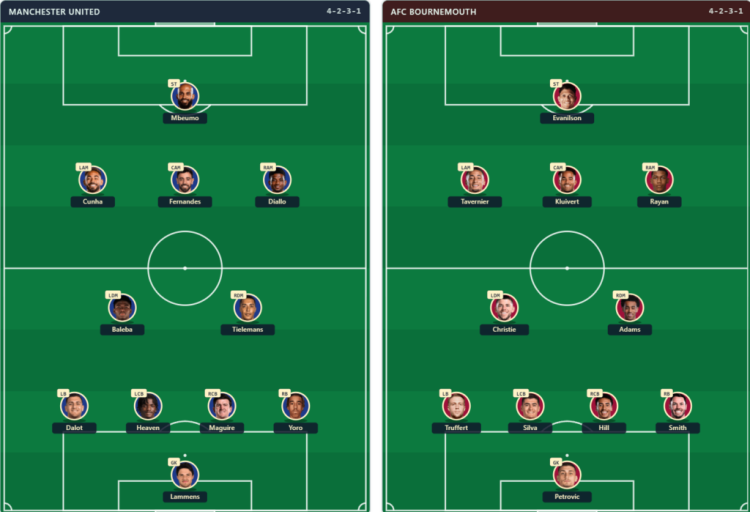
Probable Bournemouth Starting Lineup (4-2-3-1): Petrovic; Smith, Hill, Silva, Truffert; Adams, Christie; Rayan, Cook, Tavernier; Evanilson
Bournemouth have Julian Araujo, Alex Toth, and Alex Scott out with thigh injuries. Meanwhile, Eli Junior Kroupi faces a late fitness test because of a foot problem, but that doubt does not alter the predicted starting structure.
Djordje Petrovic is an automatic pick between the sticks behind Adrien Truffert, Antonio Silva, James Hill and Adam Smith, with the visitors moving into a 4-2-3-1 setup. Tyler Adams is expected to sit at the base of midfield, while Ryan Christie should start alongside him in the double pivot.
The attacking line is where Bournemouth carry their strongest form. Marcus Tavernier should begin from the left after scoring four times and creating 12 key passes in seven Premier League appearances. Justin Kluivert supplies the central link behind Evanilson, with six shots on target from 13 attempts in five appearances. Rayan occupies the right wing, and Evanilson leads the line for Bournemouth vs Manchester United after two goals, four assists and four big chances created.
Manchester United’s 4-2-3-1 shape is designed to carry the game to Bournemouth without abandoning midfield cover. Bruno Fernandes stays between the lines, the two holders support possession, and the attacking midfielders are expected to turn control into shots rather than allow the visitors to settle.
That is a sensible response for a home side under pressure, but it requires the double pivot to protect the centre when the full-backs advance. Manchester United tend to play with the ball and attack from wide areas. They average 23 crosses and 17 dribbles per match, compared with league typical figures of 16.5 and 14.5.
On the other hand, Bournemouth’s setup has a different purpose. The 4-2-3-1 system keeps two midfielders behind the attacking three, allowing the team to send the ball forward early while preserving enough cover to accept a draw if the match becomes dangerous. Bournemouth average 58 long balls per match against a league typical 49.5, while Manchester United average 43 against the same mark.
The visitors are therefore more willing to bypass the first midfield line, and their route to territory depends on what happens after the first contact rather than on a long spell of short passing. The wider profile points to a close contest for possession but a different use of it. Manchester United average 55% of the ball and Bournemouth 50%, either side of the league’s 49.5% typical figure.
Meanwhile, the Red Devils shoot 16 times per match against 13 for the league, while Bournemouth shoot 17 times against that same typical figure. The hosts are likely to have the greater share of the ball, but that does not automatically mean they will control the more dangerous moments.
Bournemouth cross 22 times per match against 16.5 norm for the league. So, their possession can quickly become delivery into the area rather than another slow circulation. Meanwhile, Manchester United’s recent attacking intention must also survive the first direct exchange. Their recent attacking output has been modest, while Bournemouth’s chance creation and defensive control have been markedly stronger.
If the visitors win second balls after going long, the hosts’ attacking midfielders may be forced to turn and defend instead of supporting Fernandes. That is the system-level question. Can United keep their two holding players connected to the attack, or will the away side make the match a series of contests around the first pass? The central duel is Harry Maguire against Evanilson.
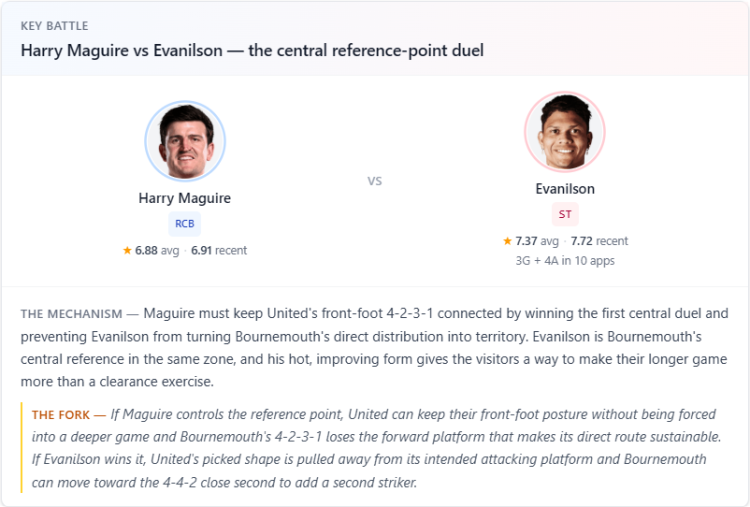
Maguire’s task is not simply to clear crosses; he must prevent Evanilson from receiving, turning and giving Bournemouth a platform to advance. The Bournemouth striker’s movement offers the visitors a way to make their direct play purposeful, while Maguire’s recent form gives United the defender most capable of absorbing that pressure. There is little spare protection if the duel is lost. United’s shape is meant to attack, so a centre-back dragged into repeated recovery actions can pull the whole formation backwards.
If Maguire controls that reference point, Manchester United should be able to keep their attacking midfield line high and make Bournemouth defend the longer periods. The Cherries will then have to build more patiently, reducing the value of their preferred direct route.
If Evanilson wins the first contacts, Michael Carrick’s team risk being pushed away from their intended platform, and Rose has the option of switching to 4-4-2 with a second striker from the opening phase. That change would give the visitors another target and make United’s centre-backs defend a more constant two-man threat.
Amad Diallo against Adrien Truffert is a separate duel rather than a second version of the same battle. Amad attacks from United’s right, where Truffert must protect Bournemouth’s left while still offering width in possession.
If Amad carries the ball beyond him, Bournemouth’s midfield may have to collapse towards that side and leave Fernandes more room centrally. If Truffert holds the channel, Manchester United may be pushed into a narrower attack and asked to create through a congested middle.
We predict a Bournemouth win, but only with medium confidence. The Cherries have the more convincing current platform. Across their last five matches they average 2.35 xG and 0.65 against, with three clean sheets. Manchester United, on the other hand, average 1.06 xG and 1.39 xGA in the same window, and they have not kept a clean sheet.
That difference matters because United’s chosen attacking approach asks them to expose space behind the ball, while Bournemouth can remain patient if the opening is not immediately available. The strongest case against Bournemouth is Manchester United’s ability to turn home possession into sustained pressure.
Bruno Fernandes has the creative responsibility, Amad Diallo can attack Adrien Truffert’s channel, and United’s shot volume suggests they should create opportunities if they keep the ball in the final third. A fast start could force Bournemouth to abandon their controlled approach, especially if James Hill and the midfield screen are repeatedly asked to defend close to their own penalty area.
Manchester United do not need to dominate every phase; they need one spell in which Bournemouth’s wide defenders are pinned and the visitors’ direct outlet is cut off. Even so, Bournemouth look better equipped to absorb that pressure and produce the more repeatable chances. The likely scoreline range is 1-2, 1-1 or 0-1, with the visitors’ ability to turn central contests into territory giving them the edge.
Marco Rose has a clear in-game lever if Manchester United begin to dominate the central spaces. He can move Bournemouth from the 4-2-3-1 formation into a 4-4-2 and add a second striker from the opening phase of the next spell.
That would give Evanilson closer support, make the first direct ball more difficult to defend and ask United’s centre-backs to deal with two forwards rather than one. It is a practical adjustment that protects Bournemouth’s route into the match without requiring them to abandon their wider threat.
