

Aston Villa vs Sunderland at Villa Park will be a battle between two teams seeking momentum after stop-start Premier League campaigns so far.
Sunderland’s 1-0 win over Chelsea at the Stadium of Light changed the mood around Regis Le Bris and his team. On the other hand, Aston Villa’s 4-4 draw at Manchester United exposed the cost of their defensive lapses.
The Black Cats protected their lead after Enzo Le Fee converted a penalty in the first half; Villa, by contrast, surrendered a two-goal advantage in stoppage time after appearing to have the match won. This is a meaningful meeting rather than a season-defining one, but the home side are chasing the top four, while Sunderland are still trying to pull clear of the relegation fight.
Aston Villa need the points to keep their higher ambitions credible, and another dropped lead would deepen the pressure around Unai Emery after a painful collapse at Old Trafford. Their unbeaten Premier League run has reached six matches, so the underlying mood is not one of crisis.
However, the recent results have made defensive control the immediate test. Villa carry attacking belief into this fixture, yet their last outing showed that producing chances and protecting a lead are separate problems. The absence of Matty Cash and the doubt over Johan Manzambi could also reduce the flexibility of their defensive and wide rotation.
Meanwhile, Sunderland are seeking to turn the Chelsea result into a change of direction rather than a single encouraging afternoon. Their victory lifted them from the bottom, but the wider run has been difficult and the cost of another defeat at Villa Park would be renewed pressure near the relegation places.
Le Bris has been vindicated by the response against Chelsea, and his side arrive with more belief in their compact, direct identity. However, Granit Xhaka is missing and Brian Brobbey remains a doubt, however, so Sunderland must find a way to retain their threat without losing the control that made the latest win possible.
Aston Villa’s probable XI keeps the familiar 4-2-3-1 shape intact, with Zion Suzuki behind a back four of Taylor Harwood-Bellis, Victor Lindelof, Pau Torres, and Ian Maatsen. Lindelof, ever-present at the back, should provide the continuity the hosts need against Sunderland’s direct entries, while Torres is expected to keep the left-sided centre-back role.
Harwood-Bellis has only one appearance and one start this season, but he is the available specialist for the right-back position with Matty Cash out with a concussion. Cash’s absence removes an established defensive option, while Johan Manzambi is doubtful with a calf problem and could affect the attacking rotation.
As for the midfield unit, Boubacar Kamara and Leon Goretzka should form the double pivot. Kamara has been a mainstay in the middle of the park, and his job is to screen the defence rather than chase the game forward. Goretzka’s role here is primarily to collect second balls and give Kamara cover.
Ahead of them, Alysson is expected on the right, John McGinn centrally, and Emiliano Buendia from the left, with Nicolas Jackson leading the line. Jackson has six goals and one assist from nine starts, the kind of form that makes him a candidate for FPL captaincy this weekend. He is the central reference Villa’s attack needs, and Buendia also brings penalty responsibility.
Villa are missing Amadou Onana (knee) and Matteo Ruggeri (thigh), while Cash is also unavailable. Manzambi is the separate doubt rather than an absence, and his status matters because Villa already have fewer established options around the wide and attacking positions. The expected front four therefore carries more of the creative burden, with McGinn’s arrivals and Jackson’s movement especially important.
Probable Aston Villa Starting Lineup (4-2-3-1): Suzuki; Harwood-Bellis, Lindelof, Torres, Maatsen; Kamara, Goretzka; Alysson, McGinn, Buendia; Jackson
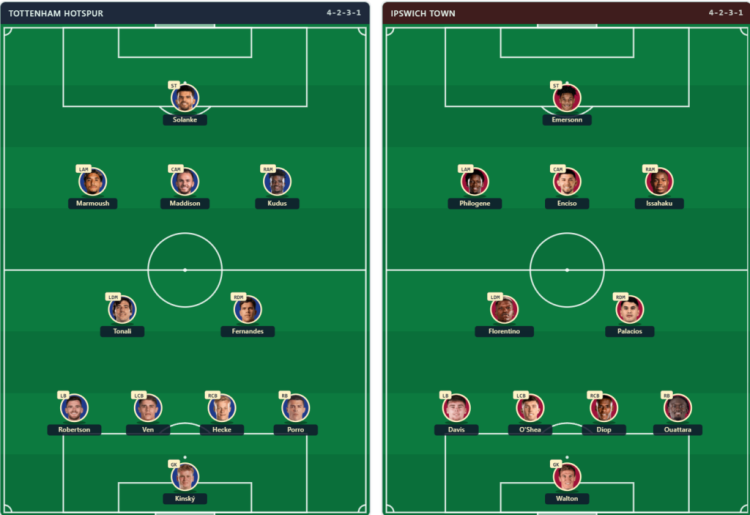
Probable Sunderland Starting Lineup (4-2-3-1): Roefs; Hume, Mukiele, Alderete, Reinildo; Ahoka, Sadiki; Meunier, Le Fee, Angulo; Isidor
Sunderland also retain their 4-2-3-1 setup. Robin Roefs starts behind Trai Hume, Nordi Mukiele, Omar Alderete, and Reinildo Mandava, with Mukiele expected to handle the central duel against Nicolas Jackson. The versatile defender has started eight games and has two big chances created, an unusual contribution for a centre-back that underlines his ability to step into the game when Sunderland regain the ball.
Noah Sadiki and Jules Ahoka should sit in the double pivot. Sadiki is a mainstay in the middle and has supplied eight key passes, while Ahoka has only 111 minutes from two appearances and replaces Xhaka in the right-sided holding role.
Thomas Meunier, Enzo Le Fee, and Nilson Angulo make up the attacking midfield line behind Wilson Isidor. Le Fee is Sunderland’s main connector, with three goals, one assist, 16 key passes, and four big chances created in ten starts. Isidor provides the direct central outlet in the absence of Brian Brobbey.
Sunderland are without Xhaka (calf), Dan Ballard (thigh), and Romaine Mundle (knee); Habib Diarra (thigh) and Brobbey (hamstring) are doubtful. That leaves Ahoka with a greater defensive responsibility and puts more pressure on Le Fee to connect the midfield to Isidor.
Both sides should use a 4-2-3-1 formation, but the similarity ends there. Aston Villa are expected to carry the game forward while preserving the double pivot behind their attacking players. Their shape gives Nicolas Jackson a fixed central reference and allows John McGinn to attack the second-ball space behind him.
Sunderland’s version is more cautious. The Black Cats want to pursue the win, but they can also protect a draw. So, their two holding midfielders should stay connected to a compact back four rather than turn the match into an open exchange. The profiles show a clear difference in how the match may be advanced.
Aston Villa average 44.5% of the ball and Sunderland 48%, against a league typical 48.5%, meaning neither side is built around overwhelming control. The hosts attempt 7.5 crosses per match and Sunderland 17, compared with a league typical 16.5; the visitors are more willing to use width and delivery, while Villa are more inclined to move the ball through carries.
Meanwhile, Unai Emery’s men attempt 15.5 dribbles against Sunderland’s 12.5, with the league typical figure at 14.5. That puts the responsibility on the home side’s attacking players to beat the first defender rather than simply move the block from side to side. The more important separation comes in the long game.
Aston Villa play 44 long balls per match and Sunderland 60.5, against a league typical 49.75. The visitors are therefore more likely to bypass midfield and compete for territory beyond Villa’s first line. The Villans’ double pivot must win the next action after those entries; if Boubacar Kamara and Leon Goretzka cannot secure the second ball, the home side may be pulled into the open match their structure is supposed to avoid.
Sunderland also make opponents’ passing fall 1.80806 below their own normal level, while Villa produce a drop of -3.41111, against the league typical 0.0613688. The Black Cats’ compactness can make Villa’s first pass forward uncomfortable, especially if the home side’s dribblers receive with their backs to goal. That leads to the main contest: Nicolas Jackson against Nordi Mukiele.
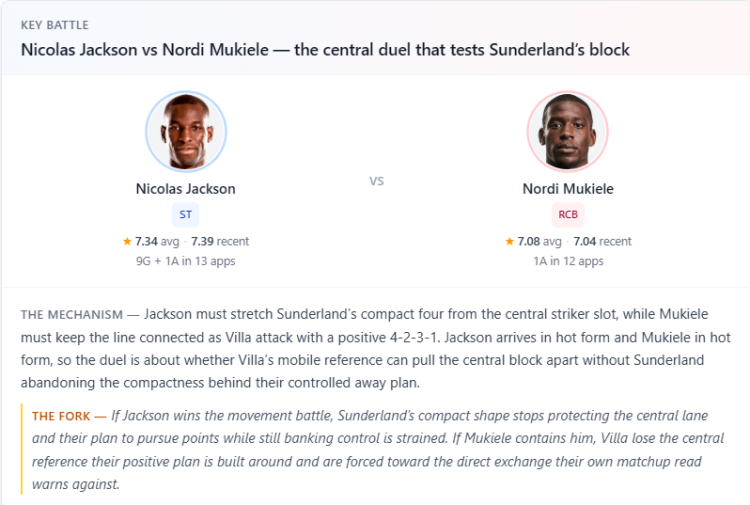
Jackson has the movement to stretch a compact back four, while Mukiele’s task is to keep the defensive line connected and prevent the striker from opening the central lane. Both arrive in strong form, so this is not simply a question of one player attacking a weakness.
If Jackson wins the movement battle, Sunderland’s block will have to break its distances and Enzo Le Fee’s side will lose the control-first platform behind it. If Mukiele contains him, Villa lose the central reference around which their positive plan is built and may be forced into the direct exchanges the Black Cats prefer.
Behind that duel is Boubacar Kamara against Enzo Le Fee. Kamara has to screen the space in front of Villa’s centre-backs, while Le Fee must receive between the lines and connect Sunderland’s long entries to Wilson Isidor.
If Kamara wins that duel, Sunderland’s route from second ball to attack is cut. If Le Fee escapes it, Aston Villa’s double pivot no longer protects the central space and the home side can be dragged away from their controlled structure.
We predict an Aston Villa win, albeit with medium confidence. The hosts have the more positive plan and the clearer central attacking reference, while Nicolas Jackson’s movement gives them a way to disturb Sunderland’s compact shape without abandoning the two-man screen behind the ball.
Villa’s season attacking balance also gives them the stronger finishing platform. Their xG is 0.268 above their actual goals, whereas Sunderland’s actual goals are 7.792 below expectation. That points to a gap between the chances Sunderland have created and the goals they have converted.
The strongest case against Villa is Sunderland’s direct route into a defence that has not been reliable enough. The hosts have conceded an average of 2.12 xG in the recent aggregate and kept no clean sheets across it. If Sunderland win the second balls from their long entries, Enzo Le Fee can receive behind the first line and turn the match towards Wilson Isidor before Villa’s double pivot has time to reset.
The win over Chelsea showed that Sunderland can manage a lead once they have it, while Villa’s collapse at Manchester United demonstrated that a promising home performance can still become vulnerable late on. The scoreline range is 2-1, 2-0 or 1-1. Unai Emery’s men are the more likely winners, but the draw remains live because Sunderland can protect the central areas and Villa’s defensive control has not matched their attacking output.
The remaining uncertainty around Aston Villa’s attacking rotation could change how much support Jackson receives during the match. If the home side keep enough movement around him, Sunderland’s compact block will have to defend several points at once.
If that rotation becomes cautious, the visitors can keep the central lanes narrow and make Aston Villa rely on low-percentage deliveries. That selection detail may decide whether the home side turn their territorial pressure into the narrow victory the prediction expects or allow Sunderland to carry the game into a draw.
