
Southampton vs Portsmouth at St. Mary’s on Sunday will be a key South Coast Derby with both teams eager to step up after slow starts to the new campaign.
Southampton’s manager, Tonda Eckert, was cleared to continue after the Spygate investigation this week, while Portsmouth arrive with a three-game unbeaten run but a sizeable injury list. That contrast gives this south-coast rivalry its edge.
The hosts have regained stability around their manager, whereas the visitors have to protect a decent recent sequence with fewer settled options. The last four league meetings ended in draws, but Southampton’s current home record gives this fixture a different feel.
The result matters to both clubs without making the afternoon decisive. Southampton can move towards the promotion places with victory, while defeat would leave them remaining in the mid-table spots. Portsmouth need points to ensure this is not a survival campaign, yet a loss would not make the season irretrievable.
Southampton’s home advantage is built on a strong start under Tonda Eckert, including four victories at St. Mary’s and 15 goals scored. Across the recent run they have scored ten and conceded six, and the manager’s reprieve has buoyed the squad. They should therefore be willing to take the game to Portsmouth rather than protect the point.
The main complication is defensive. The Saints has not kept a clean sheet in that recent spell, so control with the ball has not always meant control of the score. Meanwhile, Portsmouth’s unbeaten run has steadied a poor opening run. They have become harder to beat without yet becoming prolific.
The away side’s position makes every point useful, but the early stage of the campaign means they can accept a measured away performance rather than chase victory at any cost. The injury crisis is likely to influence that approach, particularly in defence and at centre-forward.
Southampton’s predicted 4-2-3-1 setup has been their consistent recent choice, and the back four should be built around Ryan Manning, Keven Schlotterbeck, Nathan Wood, and James Bree. Manning brings an attacking outlet from left-back and has supplied 14 key passes in eight appearances, while Schlotterbeck has started all six of his matches and has contributed a goal.
Daniel Peretz should start in goal, but his muscle issue requires a late fitness check rather than a routine selection. Meanwhile, Caspar Jander is out with a hamstring injury, so he cannot provide another midfield option, leaving James Ward-Prowse and Flynn Downes as the expected holding pair. Their job is to give the attacking line protection without reducing Southampton’s ability to sustain pressure.
Finn Azaz should operate centrally behind Cyle Larin, with Leo Scienza and Kuryu Matsuki either side of him. Azaz has three goals and four assists in eight appearances, and his 15 key passes lead the squad.
Scienza has started eight times and has added two goals and two assists, while Larin is the fixed reference up front after scoring seven times in eight outings. Southampton’s attack is therefore expected to run through Azaz’s passing and Larin’s finishing, with Scienza providing the more forceful left-sided threat.
Probable Southampton Lineup (4-2-3-1): Peretz; Bree, Wood, Schlotterbeck, Manning; Downes, Ward-Prowse; Matsuki, Azaz, Scienza; Larin
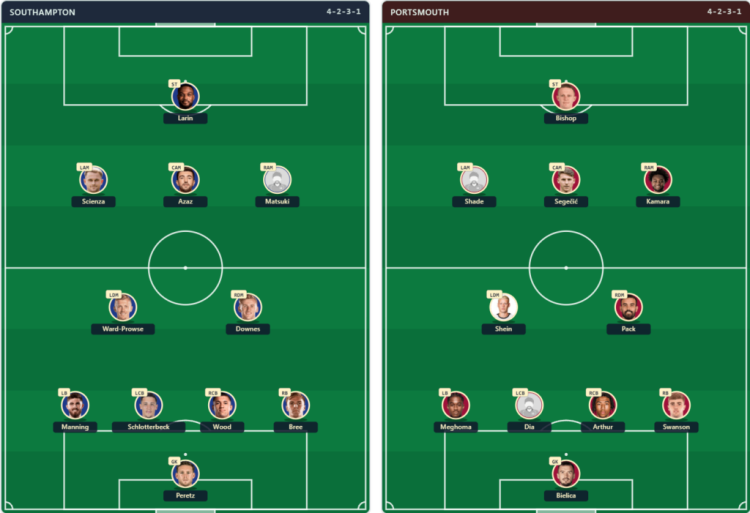
Probable Portsmouth Lineup (4-2-3-1): Bielica; Swanson, Arthur, Dia, Meghoma; Pack, Shein; Kamara, Segecic, Shade; Bishop
Portsmouth are also expected to use a 4-2-3-1 setup vs Southampton, with Daniel Bielica in goal behind Jayden Meghoma, Madiodio Dia, Benjamin Arthur, and Zak Swanson. Dia is expected to start after Conor Shaughnessy’s groin injury forced him off in the draw at Fratton Park, although Shaughnessy remains doubtful rather than a confirmed absentee.
Mark Kosznovszky and Franco Umeh are out, while Keshi Anderson remains unavailable due to a quad tear. Marko Milovanovic is doubtful with a calf issue sustained against Cardiff City, so Colby Bishop is expected to lead the line.
Bishop has four starts among seven appearances and has put all four of his shots on target, making him a more reliable focal point than his single goal might suggest. Marlon Pack and Rocco Shein should form the midfield base, although both are probable calls and each has struggled for form recently. Pack’s selection matters most because he has to protect the space in front of the back four.
Adrian Segecic should remain the central creator, with Tyrese Shade on the left and Abu Kamara on the right. Segecic leads the squad for key passes with 13. Kamara has also started every match in which he has played and has 13 key passes of his own, while Shade has contributed one assist in a smaller run of appearances.
Both teams should line up in a 4-2-3-1 formation, yet the instructions behind that shape are not the same. Southampton’s two holding midfielders are there to support the attacking midfielder and wide players while keeping the side high up the pitch. Portsmouth’s pair have a more conservative job: stay connected to the back four, support Adrian Segecic and Colby Bishop, and avoid turning the game into a series of defensive breaks.
Southampton have kept an average possession of 61% thus far this season against Portsmouth’s 54%, with the league-typical figure at 48.5%. That is the clearest difference in how the match is likely to be played. Tonda Eckert’s men should have more of the ball and more territory, while the visitors will try to use their possession in shorter, calmer spells.
Southampton also shoot 17 times per match against Portsmouth’s 14, with the league typical figure at 12.75. The home side’s greater appetite for attempts should test whether Portsmouth can keep their box protected for long periods.
Meanwhile, Southampton have been less direct than Portsmouth, with the home side recording 44 long balls per match against the visitors’ 52; the league typical figure is 57.25. That points towards the hosts building through the midfield and attacking line rather than bypassing it. Portsmouth, meanwhile, may use the longer route when Southampton push their full-backs forward, particularly if Bishop can contest the first ball and bring Segecic into the next phase.
The main system question is whether Pompey can keep their midfield two close enough to Bishop while Southampton circulate Finn Azaz, Leo Scienza, and Kuryu Matsuki around the front of the block. Southampton are prepared to carry the game to the visitors while preserving their structure.
Portsmouth want to win if the opportunity appears, but they can settle for a draw and should avoid opening the spaces that would make Southampton’s possession dangerous. That makes the first defensive phase more important than an isolated counterattack. If the away side’s lines separate, Southampton should generate repeated entries; if they remain compact, the match can stay within Portsmouth’s preferred limits.
The most important duel is Leo Scienza against Zak Swanson. The Southampton winger is expected to attack the left lane with confidence, while Swanson must defend that channel without being dragged too far from the centre-backs.
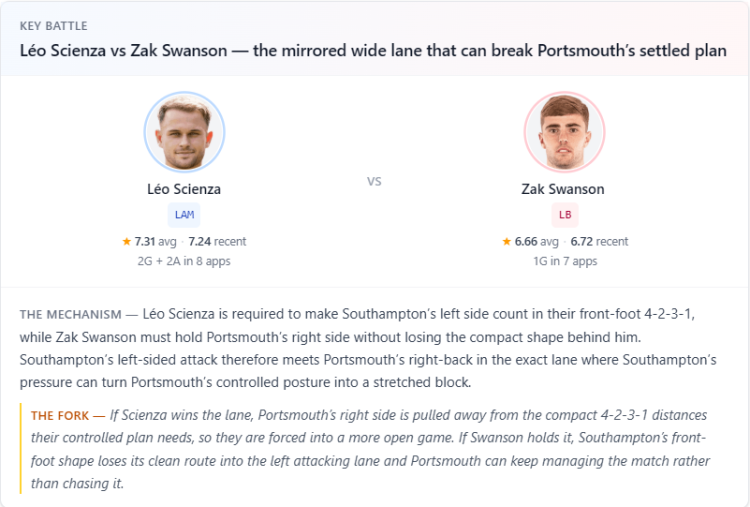
If Scienza wins the lane, Portsmouth’s right side will be pulled away from the compact distances their plan requires, forcing them into a more open game. If Swanson holds his position, Southampton lose their cleanest route into that flank and the visitors can continue managing the contest rather than chasing it.
Behind Swanson, Benjamin Arthur and the midfield screen must prevent the opening from becoming a chain reaction. Behind Scienza, Ryan Manning gives Southampton another route into the same side, so Portsmouth cannot treat the duel as a one-player problem.
The second contest, between Finn Azaz and Marlon Pack, is more central. The Southampton playmaker wants to receive between the lines, while Pack has to screen that space without abandoning Shein. If Azaz receives freely, Pack’s protection can collapse; if the latter holds the screen, Southampton may have to move the ball around the block instead of through its main creative reference.
We are leaning towards a Southampton victory, but only with medium confidence. Their home momentum, greater attacking volume, and stronger central creative option give them the more convincing route to three points. Finn Azaz’s ability to receive behind Pack could turn sustained possession into chances, while Cyle Larin offers a fixed target once Southampton work the ball into the penalty area.
Southampton’s scoring record also supports the home angle. The Saints have produced 19 goals against 14.1415 xG, a return that suggests their finishing has added value to the underlying chance creation. The case against them is their defensive concession rate.
Tonda Eckert’s men have allowed 1.76 expected goals per match across the recent aggregate and kept no clean sheets in that sequence. If Portsmouth keep their two midfielders connected and use Kamara’s right-sided outlet to escape pressure, Bishop could receive enough service to make the draw a serious possibility.
The match therefore settles in the 2-1, 2-0 or 1-1 range. Southampton are the likelier winners, but Portsmouth’s controlled structure and the home side’s defensive looseness leave the draw live.
The late decision over Southampton’s goalkeeper is the selection call most capable of changing the feel of the game. If Daniel Peretz is ready to start, the home side can retain the planned structure; if his muscle problem prevents that, the change comes in a position where Southampton have little recent match evidence to lean on. That uncertainty does not overturn the home lean, but it adds another reason to expect Portsmouth to remain competitive if they survive the opening pressure.
