
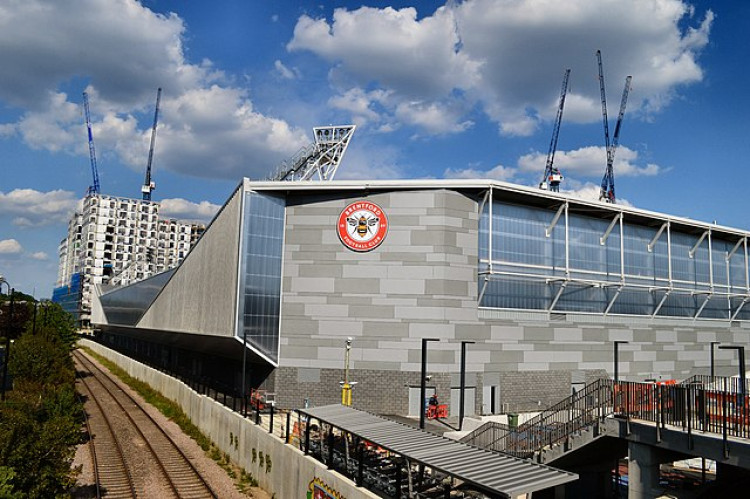
Brentford vs Everton at the Gtech Community Stadium on Monday will feature two mid-table teams in search of momentum to further their European ambitions heading into the festive period.
Brentford’s 2-0 defeat at Brighton & Hove Albion ended with an unsuccessful appeal against a red card, while Everton arrive having won three consecutive matches in all competitions. That contrast frames Monday’s meeting.
Brentford must rebuild an attack and defence disrupted by absences, whereas Everton can test a weakened opponent without abandoning the structure that has carried them forward. The points matter to both clubs in the European race, but neither side is playing a season-defining game.
A win would move Brentford towards the projected Europa League places and keep their wider European target active. A draw would preserve that pursuit, but a defeat leaves them needing to recover ground while already dealing with a disrupted squad. Their recent run has been uneven, with the loss to Brighton the latest result.
So, the immediate concern is whether the replacements can give them enough attacking threat without exposing the makeshift unit. The chosen plan is likely to be cautious about forcing the match, particularly because the side no longer has its preferred central attacking option.
Everton’s position is different. Their recent three-game winning sequence, including two in the Premier League, has put a stronger European position within reach, and victory would strengthen a live push towards the Champions League places.
A draw or defeat would not alter that ambition, but it would surrender the chance to turn current momentum into a higher position. David Moyes’s men should therefore carry more initiative into the game, backed by a productive run and a settled structure. Brentford’s defensive disruption gives Everton a reason to press their advantage rather than simply protect the point.
Brentford’s absentees are spread across the team. Rico Henry and Kaye Furo are out with hip and ankle injuries, respectively, while Aaron Hickey (thigh) and Nathan Collins (knee) are sidelined after injuries sustained on international duty. Igor Thiago is suspended for the first match of a three-game ban following the dismissal at Brighton & Hove Albion.
Fabio Carvalho and Antoni Milambo remain late fitness doubts after knocks and fitness concerns respectively. Thiago’s absence removes the main central attacking option, while the defensive injuries leave Sepp van den Berg and Kristoffer Ajer as the selected central pairing in front of Caoimhin Kelleher.
Brentford should start in a 4-2-3-1 formation vs Everton, with the shape best preserving Mathias Jensen’s position between midfield and attack. Kelleher is an automatic pick between the sticks, with Michael Kayode and El Hadji Malick Diouf at full-back. Kristoffer Ajer offers the more established defensive presence on the right of the centre-back pairing, while van den Berg comes in as his partner.
As for the midfield unit, Vitaly Janelt and Mamadou Sangare should form the double pivot; Janelt has started nine matches, scored twice and carries a 7.06 average rating, so his ability to cover the deeper areas is important to the reshuffle. Jensen should operate ahead of them, where his six key passes and two big chances created in six appearances suggest a link that the alternative two-striker arrangement would remove.
Dango Ouattara is expected to start on the right wing, while Keane Lewis-Potter should provide the left-sided outlet. Kevin Schade replaces the suspended Thiago and brings three goals from nine starts, with seven of his 19 shots on target. That is a different reference point from the absent Brazilian, but it gives Brentford a direct central route without sacrificing the attacking midfielder.
Probable Brentford Starting Lineup (4-2-3-1): Kelleher; Kayode, Ajer, van den Berg, Diouf; Sangare, Janelt; Ouattara, Jensen, Lewis-Potter; Schade
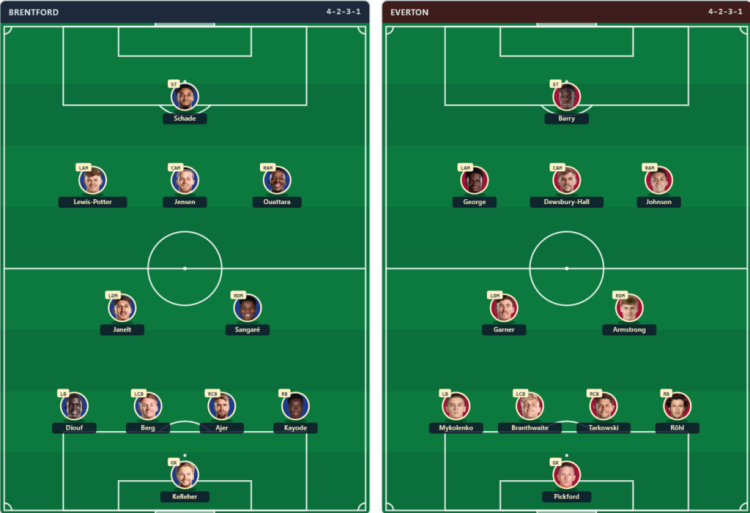
Probable Everton Starting Lineup (4-2-3-1): Pickford; Rohl, Tarkowski, Branthwaite, Mykolenko; Armstrong, Garner; Dibling, Dewsbury-Hall, George; Barry
Everton have only Jack Grealish unavailable, an internal suspension that does not alter the expected starting structure. Their 4-2-3-1 shape should remain intact, with Jordan Pickford behind Vitaliy Mykolenko, Jarrad Branthwaite, James Tarkowski, and Merlin Rohl.
As for the midfield unit, James Garner and Harrison Armstrong should form the double pivot, protecting the attacking line rather than leaving the defence exposed. Kiernan Dewsbury-Hall is the central reference behind Thierno Barry.
Dewsbury-Hall has made ten starts, supplied 22 key passes and created nine big chances, while Barry has started all ten games and scored six goals. Tyrique George is expected to start on the left, with Brennan Johnson the probable right-sided choice, though Tyler Dibling presents an alternative. With Barry fixed up front and the double pivot preserved, Everton have fewer structural decisions to make.
Both sides are expected to use a 4-2-3-1 formation, but they will not use it in the same way. Brentford should try to win while keeping the game manageable, retaining two midfield screens and avoiding the need to chase an open contest. Everton are more likely to carry the match towards Keith Andrews’s team, using the same basic structure with greater intent and allowing Dewsbury-Hall to advance behind Barry.
Brentford’s habits point towards a side that accepts less of the ball than the league norm and looks for width as an escape route. They average 43% possession against a league typical 49%, while their 18 crosses per match compare with 16 for the league.
Everton’s corresponding ball share is 46%, still below that typical figure, and their 19.5 crosses are also above the league reference. The important difference is not simply who crosses more. Brentford need those wide attacks to release pressure, while Everton can use their width to support a more assertive central approach. The carrying contest should favour the home side’s wider players.
They average 15 dribbles per match against Everton’s 12.5, with the league typical at 14. That gives Keane Lewis-Potter and Dango Ouattara a way to move the game away from the crowded centre, particularly if Everton’s full-backs push forward. The danger is that Brentford’s release disappears if Merlin Rohl and the right side contain Lewis-Potter, leaving the home team with fewer ways to advance while keeping its midfield cover.
Everton bring the greater appetite for attempts, averaging 15.5 shots per match compared with Brentford’s 13, against a league typical 13. Their game also contains more aerial pressure than the usual Premier League contest, which suits Barry as a central outlet. The away side’s front-foot plan therefore tests the exact area Brentford have had to rebuild.
Kristoffer Ajer and Sepp van den Berg must keep the central lane stable while Vitaly Janelt and Mamadou Sangare prevent the first ball from turning into a sustained attack. That is why Ajer against Barry is the main duel.
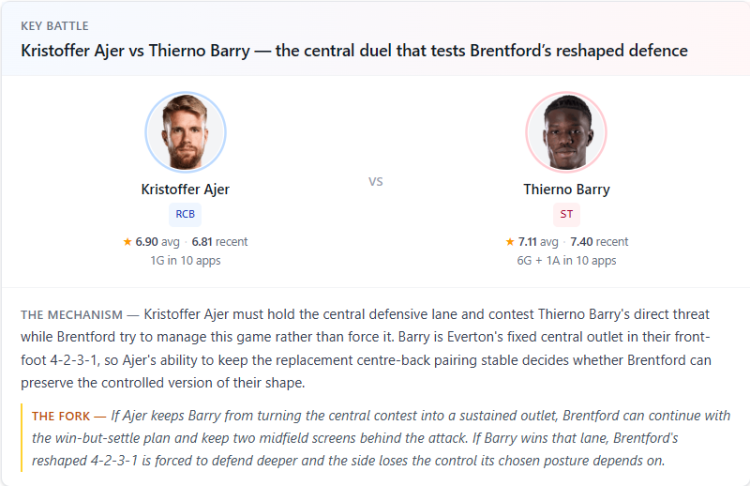
Ajer is expected to hold the defensive lane and prevent Barry from receiving, turning and making Everton’s direct play repeatable. Barry, meanwhile, is the fixed target who can make the away side’s structure advance even when Brentford deny space to the attacking midfielders. Behind Ajer there is no spare central defender waiting to absorb repeated failures; the reshaped pairing has to defend the first contest itself.
If Ajer keeps Barry from becoming a reliable outlet, Brentford can maintain the two screens and play the controlled version of their 4-2-3-1. If the French striker wins that lane, the hosts should be pushed deeper, with Everton’s shots and second balls bringing the home side closer to a defensive siege.
The secondary battle is Keane Lewis-Potter against Merlin Rohl. Brentford need the former to occupy Everton’s right side and preserve the wide release, while Röhl’s job is to remove the route that allows the home team to attack without changing its balance.
We predict an Everton win, but only with medium confidence. Their stronger recent attacking and defensive aggregate gives the visitors the better statistical base. The Toffees average 1.42 xG and 1.58 xGA across their last five matches, while Brentford average 1.17 for and 1.80 against across their last four.
Those figures do not promise a comfortable away victory, but they support the view that Everton are currently creating the more convincing platform at both ends. The football mechanism is clearer than the raw numbers. David Moyes’s men can attack Brentford’s weakened centre through Thierno Barry, while Kiernan Dewsbury-Hall can arrive behind him and the double pivot can protect the spaces left by the attacking line.
Brentford have a route back through their wide carriers, but that route depends on Keane Lewis-Potter and Dango Ouattara escaping pressure and on Schade giving the home side enough depth to stop Everton compressing the pitch. The strongest case against an Everton win is that the home side’s wide release could work exactly as intended.
If they draw Everton’s full-backs out, keep Barry from receiving cleanly and preserve the two midfield screens, the home side can make the match slow and narrow without needing sustained possession. Kevin Schade has enough finishing evidence to punish one good delivery or transition, and the away side’s forward approach would leave them vulnerable if their central protection arrives late.
The scoreline band is 1-2, 0-1 or 1-1, so the match is likely to be close rather than expansive. The draw is a serious alternative if Brentford’s reshaped defence survives the first central exchanges.
The important in-game lever belongs to Brentford. If the 4-2-3-1 formation cannot create enough presence around Schade, the home side can move to a 4-4-2 setup and place two forwards against Everton’s centre-backs.
That would increase the pressure on the away defensive pair, but it would also remove Jensen’s attacking-midfield link and leave Brentford with less connection between the two lines. The decision should depend on whether the wide release is still functioning, not simply on the scoreline.
