
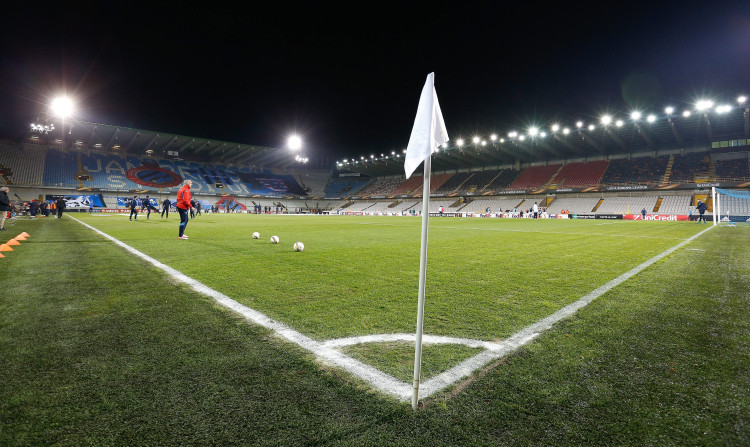
Club Brugge vs Liverpool at the Jan Breydel Stadium on Wednesday will be a crucial UEFA Champions League clash between two in-form teams seeking a top-eight finish.
Liverpool’s 3-2 defeat to Fenerbahce in Istanbul changed the tone around this UEFA Champions League meeting, particularly after three set-piece concessions despite taking the lead twice. Club Brugge arrive from the opposite direction, having beaten PSV Eindhoven 2-1 to clinch a third consecutive European victory.
This is a match about progression in the league phase. While a result matters to both teams, neither side has been given a qualification equation that makes the game strictly win-or-bust. For Club Brugge, another positive result would extend an exceptional European run and strengthen the belief created by their recent victories.
A defeat would not erase that momentum, but it would expose the defensive risk of facing a stronger opponent after a spell in which the home side have been allowed to play with confidence. Their recent domestic evidence also supports the mood. They won 5-1 away at KV Mechelen and have gone 11 matches unbeaten.
Across the last three games in the Champions League, Club Brugge have scored nine goals and conceded four. The question is whether that attacking confidence can survive against a Liverpool side with more control of the ball. Speaking of the Reds, they need to turn recovery into a European result after the setback in Istanbul.
Wins over Crystal Palace and Manchester United have kept the response positive, but another loss would leave the set-piece collapse looking like a recurring structural problem rather than a one-off.
Their recent attacking output has remained strong, with 11 goals across the last five matches, while five concessions and two clean sheets show a side that is not simply trading chances every week. Club Brugge’s momentum makes this a dangerous away fixture, so Liverpool are likely to value control over an unnecessarily open contest.
Club Brugge are without Joel Ordonez because of a metatarsal fracture and Jan Virgili because of a groin injury. The absences narrow the available squad without forcing a different shape in the expected XI. Yann Sommer should feature between the sticks, with Kyriani Sabbe, Jorne Spileers, Brandon Mechele, and Joaquin Seys forming the back four.
The home team should line up in a 4-1-4-1 formation, with Freddie Potts being the single holding midfielder. Hans Vanaken and Hugo Vetlesen should operate ahead of Potts, who gives the shape a clear screening point even though the rest of the midfield has rotated more.
On the flanks, Carlos Forbs should continue on the right after two goals, three assists, and three big chances created in the 2026/27 UEFA Champions League, with Mamadou Diakhon the likely starter on the other side. Nicolo Tresoldi leads the line and is the penalty taker; his five goals from four starts make him the obvious central reference.
Probable Club Brugge Starting Lineup (4-1-4-1): Sommer; Sabbe, Spileers, Mechele, Seys; Potts; Carlos Forbs, Vetlesen, Vanaken, Diakhon; Tresoldi
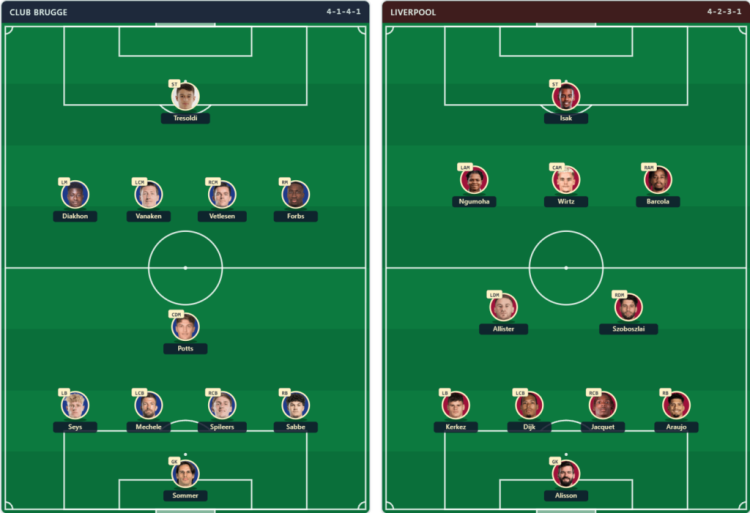
Probable Liverpool Starting Lineup (4-2-3-1): Alisson; Araujo, Jacquet, van Dijk, Kerkez; Szoboszlai, Mac Allister; Barcola, Wirtz, Ngumoha; Isak
The away side will be without three players, while Federico Chiesa and Wataru Endo are unavailable because of eligibility issues. Hugo Ekitike is recovering from an Achilles tendon rupture, while Giovanni Leoni and Conor Bradley are completing their rehabilitation from their respective knee injuries. Additionally, Andoni Iraola is sweating over the fitness of Cody Gakpo and Ryan Gravenberch.
Liverpool should line up in a 4-2-3-1 formation vs Club Brugge rather than reshaping around the absences. Alisson starts behind Ronald Araujo, Jeremy Jacquet, Virgil van Dijk, and Milos Kerkez. Van Dijk is the organiser at the heart of the defence, although Liverpool need a cleaner response on dead balls than they produced in Istanbul.
The midfield pairing should be Alexis Mac Allister and Dominik Szoboszlai, with Florian Wirtz ahead of them. Wirtz is the creative hub, supported by Rio Ngumoha on the left and the Bradley Barcola on the right.
Wirtz has a goal, an assist and nine key passes, while Barcola has scored three times from his four appearances. Alexander Isak is expected to lead the attack. His season return is one goal and one assist, though his role here is less about dropping away from the centre than giving Liverpool a fixed target against the home side’s lone pivot.
Club Brugge’s 4-1-4-1 setup is designed to keep two midfield lines connected behind Nicolo Tresoldi. Freddie Potts has to protect the space in front of the centre-backs, while Hans Vanaken and Hugo Vetlesen can support the striker without abandoning the structure. Liverpool’s 4-2-3-1 system offers the opposite kind of security.
Alexis Mac Allister and Dominik Szoboszlai sit behind Florian Wirtz, giving Liverpool two players to help control the central areas while the attacking midfielder works between the lines. Both teams are expected to pursue the win without turning the match into an uncontrolled chase. So, the first phase may be cautious even if the attacking talent is strong.
Liverpool’s recent profile points to a side that wants the ball and uses width to progress. They have averaged 58% possession against a UEFA Champions League-typical figure of 51% across four matches, while their 20 crosses per match sit above the league’s 14.5 norm.
The Reds also average 23.5 take-ons compared with 17 for the typical team in the same competition, suggesting that their control is not purely about circulating possession; they try to move defenders with carries and wide attacks.
Club Brugge have shown that they can remain dangerous without dominating the ball; at PSV they won with 38% possession and produced 1.11 xG. Liverpool therefore need to make their control produce territorial pressure rather than simply allowing the home side to wait for the next transition or restart.
The dead-ball phase is the clearest route for Club Brugge to disturb that plan. They produced 0.98 xG from set pieces against Inter and 0.26 against PSV, while Liverpool’s defeat at Fenerbahce included 0.46 xGA from set plays. That gives Tresoldi and the home side’s midfield a way to threaten without pulling the 4-1-4-1 apart.
Liverpool’s recent defensive vulnerability is not just a general concern, and it directly gives Club Brugge a method that fits their chosen shape. The leading duel is Nicolo Tresoldi against Virgil van Dijk.
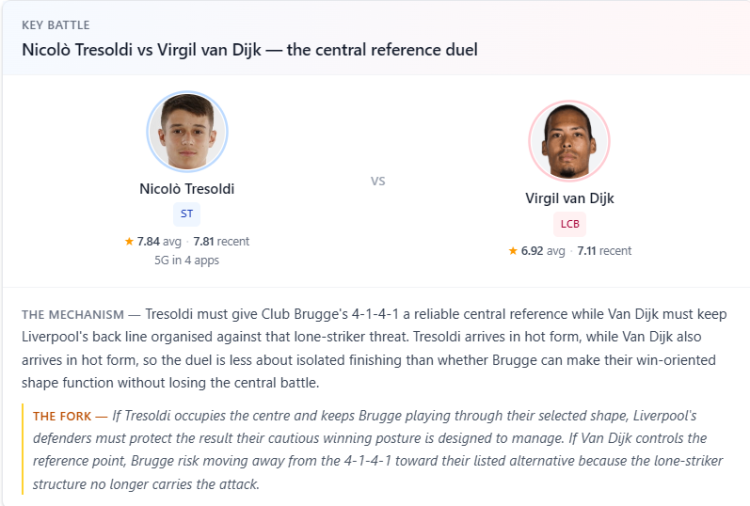
The in-demand Tresoldi is a penalty-box finisher who needs to make the lone-striker system credible, while van Dijk is the organising centre-back who must prevent Liverpool’s controlled approach from being undermined by one central reference. Both arrive in strong form, so the contest is not simply about who wins an isolated header.
If Tresoldi can hold the ball and keep Club Brugge’s midfield close enough to attack second phases, Liverpool will have to defend deeper and protect a result that their cautious approach is meant to manage. If van Dijk controls him, the hosts may struggle to connect their two midfield lines to the attack, and they could be forced towards an extra central midfielder later on.
The second important collision is Carlos Forbs against Milos Kerkez on Club Brugge’s right. The former gives the home team a direct outlet from the right-sided midfield lane, while Kerkez has to defend that area without allowing Liverpool’s left side to become detached from its back four.
If Forbs pins Kerkez and keeps the outlet alive, Liverpool may be pulled wider than their preferred controlled structure allows. However, if the Liverpool left-back holds the flank, Brugge lose one of their clearest ways to stretch the visitors and feed Tresoldi.
We predict a Liverpool win, though only with medium conviction. Their 4-2-3-1 shape should give them the more reliable platform around the central areas, and their recent defensive baseline is stronger than Club Brugge’s attacking momentum might suggest. The hosts have averaged 3.04 xGA across their last three Champions League matches, while the Reds have produced 2.43 xG per match across their last five.
That is the clearest statistical reason to expect Liverpool to find chances even if the home side’s recent European run makes the fixture uncomfortable. The strongest case against our pick is Club Brugge’s set-piece route. Liverpool conceded three dead-ball goals at Fenerbahce, and Ivan Leko’s men have already shown that restarts can generate a substantial share of their attacking threat.
A Nicolo Tresoldi goal or a second-ball situation could force Liverpool to abandon the controlled game they want, particularly if Carlos Forbs keeps the home side advancing from the right wing. If Liverpool fail to defend the first delivery and the next phase, the match can become a much more even exchange.
The expected scoreline range is 1-2, 1-1 or 2-2. Liverpool are likelier to manage the decisive moments, but the draw remains a serious outcome because Club Brugge can threaten without needing sustained possession.
Liverpool’s clearest in-game lever is switching to a 4-3-3 formation if Club Brugge repeatedly find the space around Freddie Potts. Adding a third central midfielder would give the visitors another player to close that lane and protect the defenders behind it, but it would also remove one attacking-midfield position and reduce the number of players immediately supporting Alexander Isak. That choice may decide whether Liverpool settle the match through control or leave Club Brugge with enough central access to keep the scoreline within reach.
