
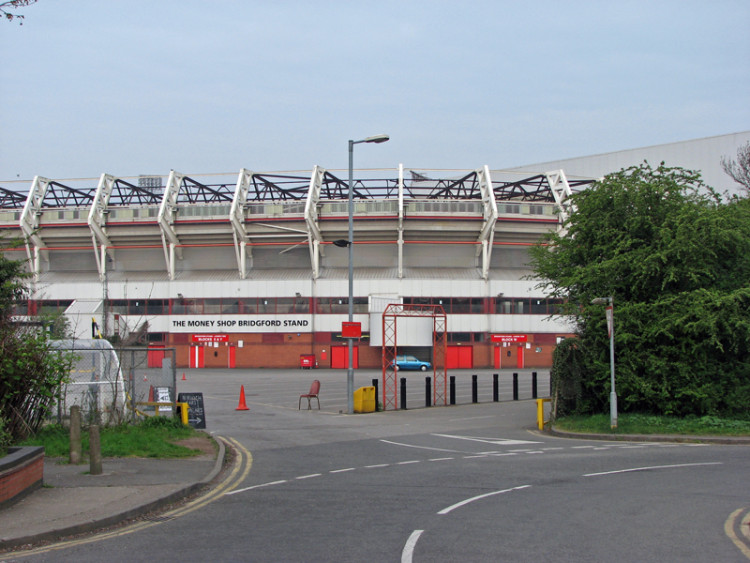
Nottingham Forest vs Chelsea at the City Ground on Friday will feature two teams in desperate need of three points and momentum to arrest their respective slides.
Nottingham Forest’s 2-0 defeat at Bournemouth exposed the same attacking weakness that has made this season so uncomfortable. On the other hand, Chelsea’s 4-1 home collapse against Leeds United left their supporters heading for the exits early and inviting pressure on Xabi Alonso. Both sides now need to steady themselves, but this is not a mathematically decisive fixture; it is a meaningful opportunity to stop a poor run becoming a deeper problem.
Forest need the response more urgently in table terms. They remain just outside the relegation zone, and even a win would move them only into the lower mid-table places rather than clear of danger. The immediate cost of another defeat is therefore continued pressure around Oliver Glasner, while a draw would stop the bleeding without changing the wider picture.
At Bournemouth, Forest had 18 shots but only one on target, an attacking return that turned territorial effort into very little danger. Their last five outings have brought four goals and seven conceded, and the Tricky Trees carry the confidence of having beaten Manchester City earlier in the campaign, but not the attacking efficiency required to build on it.
The familiar three-man structure should remain the platform for their response, although the continued absence of Nicolas Dominguez removes one midfield option and makes the physical demands on the selected pair more significant. Chelsea’s problem, on the other hand, is different.
They are eighth and still close enough to the UEFA Champions League places for a win to matter. However, the defeat to Leeds United made their current fragility impossible to ignore. A point would give Xabi Alonso some control after three defeats in the last four league matches; another loss would sharpen the questions around a side that has struggled to recover once matches turn against it.
Chelsea have scored five and conceded seven across their last five Premier League games, a run that explains why a managed away performance is preferable to an open chase. Their possession game and established attacking creators remain the route back. However, multiple defensive absences mean the backline must function without some of its usual depth.
Nottingham Forest are expected to keep the 3-4-2-1 formation that has been used throughout the season. Matz Sels should feature between the sticks behind a back three of Jair Cunha, Nikola Milenkovic, and Murillo. The trio form a settled central group rather than a wholesale defensive reset.
Daniel Munoz should occupy the right wing-back role, with Neco Williams likely to continue on the left. Munoz has eight starts, one assist, and 14 key passes, giving Forest an important source of progression from a wide defensive position. Williams has started all 11 Premier League games and has contributed 12 key passes, although his current form is scratchy after a strong start to the season.
Xaver Schlager and James McAtee should form the central pairing. McAtee has 21 key passes, second in the squad by the available ranking, while Schlager has started nine matches and added one assist. Morgan Gibbs-White and Dan Ndoye are expected to play behind Liam Delap, who should lead the line for Nottingham Forest vs Chelsea.
Gibbs-White has three assists and 28 key passes, the most in the squad, while Delap has scored three times and carries 3.4 xG from his 10 appearances. Meanwhile, Forest are without Nicolás Dominguez because of a hamstring injury and Nicolo Savona because of a knee injury.
Probable Nottingham Forest Starting Lineup (3-4-2-1): Sels; Cunha, Milenkovic, Murillo; Munoz, McAtee, Schlager, Williams; Ndoye, Gibbs-White; Delap
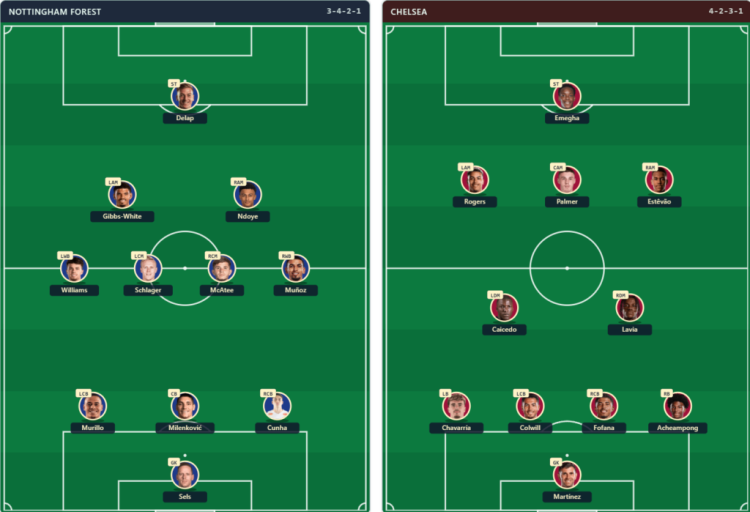
Probable Chelsea Starting Lineup (4-2-3-1): Martinez; Acheampong, Fofana, Colwill, Chavarria; Lavia, Caicedo; Estevao, Palmer, Rogers; Emegha
Chelsea should use the increasingly familiar 4-2-3-1 formation vs Nottingham Forest. Emiliano Martinez starts in goal behind Josh Acheampong, Wesley Fofana, Levi Colwill, and Pep Chavarria. As for the midfield unit, Moises Caicedo and Romeo Lavia should sit as the double pivot.
Lavia has one goal, one assist, and a 6.98 rating from nine appearances, while Caicedo has six starts and provides the more defensive selection. Cole Palmer starts centrally behind Emmanuel Emegha, with Morgan Rogers to his left and Estevao likely to take the right attacking lane.
Palmer has three goals, three assists, and 23 key passes, while Rogers, a dark horse pick for FPL captaincy for Gameweek 12, leads Chelsea’s scoring with five goals and has added two assists. Emegha has three goals and has put 13 of his 18 shots on target, a useful indication of the threat Chelsea retain through the centre.
Chelsea are missing Reece James after knee surgery, Joao Pedro with a thigh injury, and Maxence Lacroix because of a hamstring injury. Additionally, Jorrel Hato remains in the treatment room due to a lower back problem, while Jamie Gittens is closing in on returning from an ankle complaint.
Notingham Forest’s 3-4-2-1 setup is designed to keep three centre-backs behind the wing-backs while leaving Morgan Gibbs-White and Dan Ndoye close to Liam Delap. They are likely to attack with the striker early rather than spend long spells building through midfield, but their home approach should still be assertive rather than reckless.
Oliver Glasner’s men want to carry the game to Chelsea within their structure, accepting some exposure to make the two attacking midfielders relevant. On the other hand, Chelsea’s 4-2-3-1 system gives Cole Palmer a clear central connection to Morgan Rogers, Estevao, and Emmanuel Emegha while Moises Caicedo and Romeo Lavia protect the build.
The Blues are likely to pursue the win without turning every phase into a race, taking the point if Nottingham Forest’s pressure makes the match unstable. That balance matters after the defeat to Leeds United. Chelsea need to restore control, but a defensive retreat would invite the direct pressure they are trying to escape.
Chelsea have held 53% of the ball per match compared with Forest’s 49%, either side of a league typical 48.5%. So, the visitors are more likely to dictate possession even if Glasner’s charges create the more obvious moments through early passes. The Tricky Trees play 62 long balls per match against Chelsea’s 47, with the league typical figure at 50; that is the clearest stylistic divide.
Forest will try to turn the match into a sequence of first balls, clearances and second attacks. On the other hand, Chelsea will want the ball back on the ground quickly enough to bring Palmer into the spaces behind the midfield. The wider system question is what happens when Forest’s wing-backs advance.
Their width can stretch Chelsea’s full-backs and leave Gibbs-White and Ndoye close to Delap. However, the movement also asks Xaver Schlager and James McAtee to cover large areas. The away side’s double pivot can help the centre-backs deal with the first pass, then release Palmer once possession is secured.
If Forest push both wing-backs high without winning territory, Chelsea should find the wide spaces that force the home side to retreat from its intended attacking posture. The most important duel is Liam Delap against Wesley Fofana.
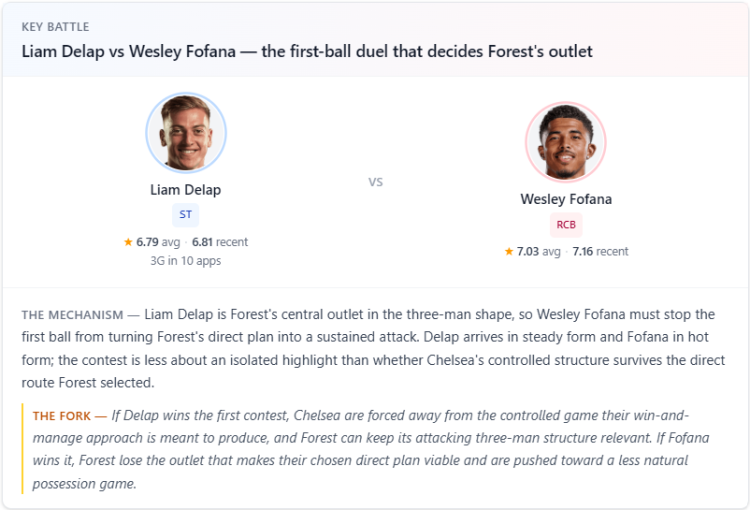
Delap is the outlet that makes Nottingham Forest’s direct game more than a clearance, while Fofana is the centre-back who must stop the first ball becoming a sustained attack. The English striker arrives with three goals and 3.4 xG, whereas Fofana is a defender Chelsea will trust in the physical contest.
There is little cover behind the duel if the first pass beats Fofana. Forest’s two attacking midfielders are positioned to attack the next phase, but Chelsea’s pivot must then protect the space in front of the remaining centre-back. If Delap wins that first contest, the visitors are pulled away from the controlled match they want and Forest can keep their three-man attacking structure active.
If Fofana wins it, Forest lose the outlet that supports their chosen plan and are forced into a more patient possession game, which is less natural for them. McAtee’s work around Palmer is the second layer. The Nottingham Forest playmaker must screen the central connector without abandoning the midfield support that allows Forest to press.
We are leaning towards a Chelsea win, held with medium confidence rather than certainty. Their 4-2-3-1 shape gives Cole Palmer a defined place between the lines, which should give the visitors the better chance of turning possession into the decisive pass. Nottingham Forest’s two-man midfield has to contain him while still supporting Morgan Gibbs-White, Dan Ndoye, and Liam Delap, which creates a difficult choice whenever Chelsea move the ball beyond the first pressure.
The away side’s attacking case is weakened by the gap between their chance creation and their finishing. They have scored nine goals from 18.1254 xG this season, a severe under-finishing problem that makes it harder to trust their pressure even when the route into the final third is working.
Across the latest five-match window, however, Forest have averaged 1.53 xG per game. So, the home side can still make Chelsea defend for long stretches. The strongest argument against the away win is Chelsea’s own defensive instability. They have an average of 1.49 xGA per match in their recent run, keeping only two clean sheets. So, Delap winning the first ball or Gibbs-White finding space could turn Forest’s direct approach into real chances.
Chelsea also arrive after conceding four at home to Leeds United, making their ability to recover from the first setback more important than their possession advantage. The scoreline most likely settles around 1-2, with 2-2 and 1-3 also fitting the match.
The final variable is Nottingham Forest’s expected central-striker call. If the player chosen to lead the line can hold up the first pass, the hosts can keep their two attacking midfielders close enough to trouble Chelsea after turnovers.
If that outlet is less effective, Forest may have to push the wing-backs even higher to create attacks, leaving Chelsea more room to play through the double pivot and find Palmer. That decision could change whether this becomes a controlled away win or a much more open evening.
